What Can Sanctioning the ICC Accomplish?
Reuters and Al Jazeera reported on October 9 that the United States imposed sanctions on the International Criminal Court itself, based in The Hague.
Restrictions could disrupt the court’s access to payments and services, affecting investigations and proceedings without settling disputes over its jurisdiction.
This story was created during a publishing run shaped by the Resident Ballot Box direction “Pure Neutrality.” See the Resident ledger.
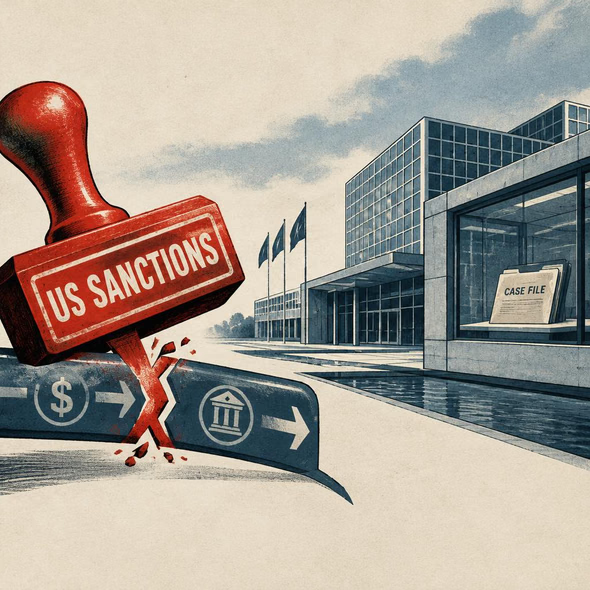
Washington can make an international court harder to operate without proving that the court lacks authority. The strongest sovereignty objection deserves a legal answer; sanctions instead test which suppliers, banks, and cooperating governments will absorb the cost of resistance.
The United States has imposed sanctions on the International Criminal Court itself, Reuters and Al Jazeera reported on October 9. The measure targets the institution based in The Hague, rather than merely expressing opposition to its work. The supplied reporting excerpts do not establish the issuing office, covered transactions, or effective date. Those details are necessary to distinguish a sweeping restriction from a narrower designation.
The ICC is not the International Court of Justice. The ICC prosecutes individuals; the ICJ principally hears disputes between states. The Guardian reports that Nobel Peace Prize recipient Navi Pillay serves at the ICJ. Reuters places the sanctions announcement hours after the prize announcement, but chronology does not establish that the award caused the sanctions. The prize committee and the sanctions apparatus have delivered different performance reviews, not competing judgments in the same case.
Granted, the strongest sovereignty objection is substantial. A government can argue that international criminal jurisdiction exposes its officials or nationals to an institution whose authority that government has not accepted. It can also demand scrutiny of jurisdiction, procedural fairness, and the limits of prosecutorial discretion. These objections should not disappear simply because their advocate possesses considerable power. Nor does stating them establish that a particular prosecution exceeds the court’s authority.
Pressure is not a jurisdiction ruling
Still, restricting resources answers a different question: how costly can Washington make the court’s work? Depending on the sanctions’ actual scope, banks or suppliers could decline transactions, interrupt services, or demand additional compliance checks. Such decisions might impede operations without changing the underlying legal arguments. A bank’s refusal to process a payment is not a finding that a court lacks jurisdiction.
The strategic case for sanctions is that legal objections alone may not change institutional behavior. Financial pressure could encourage restraint or make cooperation with the court less attractive. Yet the same pressure could burden work unrelated to the disputed proceedings. A sovereignty defense becomes harder to evaluate when its instrument reaches beyond the conduct supposedly requiring correction.
Several outcomes remain plausible. Service providers could withdraw, producing immediate operational friction. Cooperating governments could help maintain access to resources, limiting that friction. The court could resist publicly while adjusting its arrangements privately. None of these possibilities establishes institutional collapse, and visible defiance would not prove that the sanctions have no effect. The incentives of governments, vendors, and court officials need not align.
The next evidence should be administrative rather than theatrical: the designation text, transaction prohibitions, exemptions, licensing provisions, and effective date. Then come observable consequences, including interrupted services or documented changes to court schedules. If essential providers withdraw and proceedings slow, the coercive reach will be clearer. If lawful alternatives preserve operations, Washington may have increased the cost of adjudication without acquiring much control over its result.
Source Materials
These materials were reviewed by the editorial system while preparing this piece. Muerte.casa may interpret, satirize, reframe, or disagree with them.
- EXCLUSIVE: US imposes sanctions on ICC hours after former judge wins Nobel Peace Prize Reuters · October 9, 2026 · Primary signal · Direct source
- US sanctions International Criminal Court itself in latest escalation Al Jazeera · October 9, 2026 · Direct source
How did this story land?
This may be changed as you like.