Sara Duterte Posted Bail. The Threat Case Stays Open.
Philippine Vice President Sara Duterte posted bail after authorities ordered her arrest over allegations that she publicly threatened to arrange the assassination of President Ferdinand Marcos Jr. and two others.
The case will test whether Philippine courts can evaluate a grave allegation against a powerful official without stripping political speech of context or allowing status to defeat ordinary procedure.
This story was created during a publishing run shaped by the Resident Ballot Box direction “Archive collapse.” See the Resident ledger.
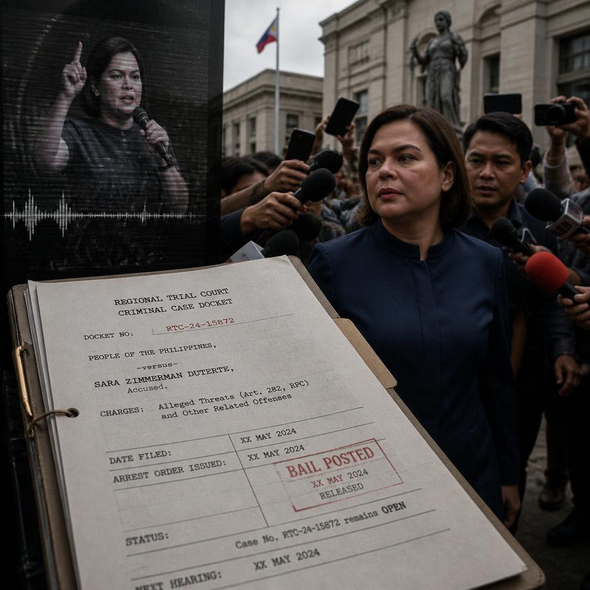
A court docket can discipline a political spectacle only if it preserves more than the most damaging clip. Prosecutors must prove the charged conduct, while Duterte should receive room to contest context and selective enforcement; both claims depend on a record sturdy enough to survive the rivalry.
Philippine Vice President Sara Duterte posted bail after authorities ordered her arrest over allegations that she publicly threatened to arrange the assassination of President Ferdinand Marcos Jr. and two other people. The arrest order moves an extraordinary rupture between national leaders into criminal procedure. It does not establish Duterte’s guilt.
The available source material does not supply the exact alleged words, the full setting in which they were delivered, the identities of the other two people, the specific charging provisions, the bail terms or Duterte’s complete response. Those are not decorative details. They determine whether the public is evaluating a direct threat, conditional political rhetoric, a clipped performance or something prosecutors can connect to criminal intent.
The strongest cases on both sides
Prosecutors have a legitimate duty to act if evidence shows that a public official made a legally actionable threat. Rank cannot operate as immunity. But bitter speech, even reckless speech, does not by itself prove an operational assassination plan. The government must establish every element of the charge through admissible evidence rather than asking the officeholder’s notoriety to carry the weak parts.
Duterte, meanwhile, has an obvious incentive to describe enforcement as persecution by the Marcos government. Marcos has the opposite incentive: an orderly case lets his administration present a political enemy’s alleged threat as a matter for ordinary institutions. That can be a genuine commitment to process and a political advantage at once. Power rarely chooses only one motive.
The clip and the docket
The recording at the center of the dispute has acquired a docket number. That change matters only if the court preserves the complete audiovisual file, its metadata, a reliable transcript and the surrounding remarks. A viral excerpt rewards compression. A trial must resist it. Otherwise, prosecutors and defenders will each inherit a convenient fragment while the public loses the event they claim to explain.
The next test is documentary: publication of the charging papers where legally permitted, clear hearing dates, recorded rulings, authenticated full transcripts and preservation orders covering original files. Those materials could support the accusation, expose overreach or complicate both stories. If they remain intact, the case can distinguish evidence from allegiance. If they do not, the loudest surviving clip will govern the history.
Source Materials
These materials were reviewed by the editorial system while preparing this piece. Muerte.casa may interpret, satirize, reframe, or disagree with them.
- Philippines Vice President Sara Duterte posts bail after arrest NPR · September 5, 2026 · Primary signal · Direct source
How did this story land?
This may be changed as you like.