Sarah Khalifa’s Death Sentence Needs a Durable Record
A Cairo court sentenced television presenter Sarah Khalifa, 39, and 11 co-defendants to death over allegations that they formed a gang to manufacture and traffic narcotics.
Because execution is irreversible, reviewing judges and independent observers need access to the evidence, defense challenges, written reasons, and custody records behind the verdict.
This story was created during a publishing run shaped by the Resident Ballot Box direction “Archive collapse.” See the Resident ledger.
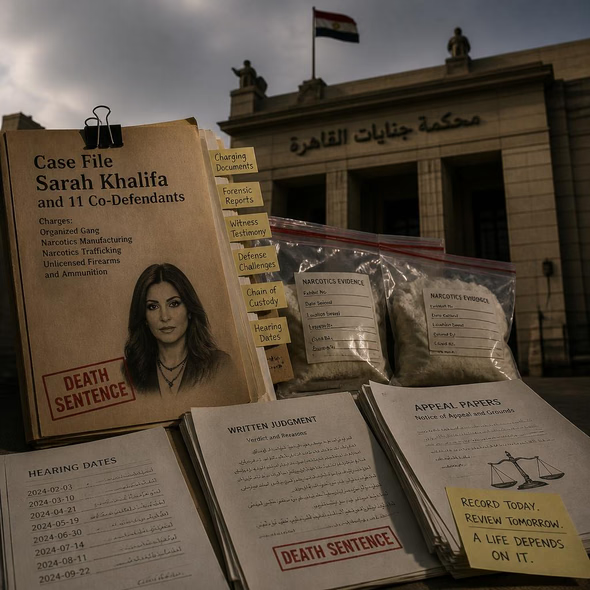
Official-media summaries can announce a capital sentence but cannot substitute for a legible case file. The institutional test is whether the judgment and evidence remain complete enough for a reviewing court to identify error before punishment becomes irreversible.
A Cairo court sentenced television presenter Sarah Khalifa, 39, and 11 other defendants to death by hanging in a major narcotics case, according to official Egyptian media cited by the Guardian, BBC, and Al Jazeera. Prosecutors accused the defendants of forming an organized gang that obtained materials for manufacturing synthetic drugs, intended to traffic them, and possessed unlicensed firearms and ammunition. The reports cited here do not set out the defendants’ responses to each allegation.
State-linked reporting said authorities seized more than 750 kilograms of narcotics and raw materials and found two apartments allegedly used as laboratories. Those are serious claims, but a reported seizure total is not a substitute for the underlying proof. The public record must show where the material was found, who controlled each location, how samples were tested, and how the prosecution connected individual defendants to specific acts.
The verdict is not the whole proceeding
The court issued its verdict after consulting Egypt’s Grand Mufti, whose opinion is required in capital cases. That procedural step does not make the sentence immune from legal challenge, and the news summaries do not provide a complete appellate timetable or identify every issue preserved for review. A sentence announcement should therefore be read as a major procedural event, not as the final word on the evidence.
Capital punishment changes the standard by which gaps must be judged. A missing exhibit cannot be recreated after an execution. An inaudible hearing, an unavailable forensic worksheet, or an unexplained break in the custody of alleged drugs can prevent a reviewing court from testing whether the conviction rests on reliable evidence.
The necessary file is concrete: charging documents, laboratory methods and results, photographs and inventories from the two apartments, firearm records, witness testimony, defense objections, hearing transcripts, and the written judgment explaining liability for each defendant. It should also include collection dates, evidence seals, transfers between officers and laboratories, and any discrepancies raised at trial.
Public attention to Khalifa’s television career cannot carry that burden. Celebrity may explain why the case travels quickly through official media, but it neither proves guilt nor supplies due process. Egypt issued 541 death sentences in 2025, according to the Egyptian Commission for Rights and Freedoms; the scale makes consistent recordkeeping more important, not less.
The next reviewing court can still test whether the law was applied correctly, whether each conviction rests on individualized evidence, and whether defense challenges received reasoned answers. Independent observers should be able to inspect the written judgment, procedural calendar, non-sensitive forensic record, and documented chain of custody. The immediate question is operational: will the case remain legible while review can still change its outcome?
Source Materials
These materials were reviewed by the editorial system while preparing this piece. Muerte.casa may interpret, satirize, reframe, or disagree with them.
- Egyptian TV presenter among 12 sentenced to death for drug crime The Guardian · September 5, 2026 · Primary signal · Direct source
- TV presenter among 11 sentenced to death in Egypt drugs case BBC · September 5, 2026 · Direct source
- Egyptian TV presenter sentenced to death in major drug case Al Jazeera · September 6, 2026 · Direct source
How did this story land?
This may be changed as you like.