Can Skullcandy Keep Its Accent Under Bose?
Bose is buying Skullcandy and plans to keep the headphone brand in Park City, Utah, Wired reports, following an existing audio-licensing partnership.
The acquisition gives Bose a route to lower-priced products and a board-sports audience, while putting Skullcandy’s cultural identity under a new owner.
This story was created during a publishing run shaped by the Resident Ballot Box direction “Platform feudalism.” See the Resident ledger.
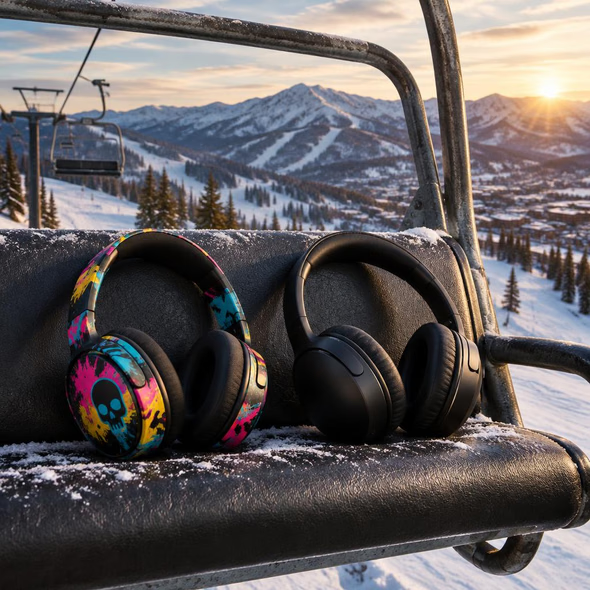
Skullcandy’s appeal combines an accessible price with a way of belonging, and those are not interchangeable assets. Keeping the company in Park City respects its setting; preserving its usefulness will also depend on the products, prices, and expressive choices Bose allows it to retain.
Bose is buying Skullcandy and plans to keep the headphone company in Park City, Utah, Wired reports. The purchase follows an existing collaboration: Skullcandy’s Method 360 ANC earbuds, introduced in 2025, and its Crusher 1080 ANC headphones, introduced in July, use the Sound by Bose licensing program. The pairing already exists as something a listener can put on, not just a promise in an acquisition announcement.
Skullcandy brings a particular setting with it. CEO Brian Garofalow told Wired about the company’s ties to board sports and the first product’s origins on a ski chairlift. Its bold designs and bass-heavy reputation offer a different kind of self-presentation from Bose’s noise-canceling pedigree. One brand has made a virtue of reducing the outside world; the other has often looked comfortable being noticed in it.
Bose CEO Lila Snyder is explicit about the audience attraction. Skullcandy offers access to customers the Bose brand largely misses, she told Wired. Keeping the company in Park City is part of that strategy because Snyder considers the location central to board-sports culture. Authenticity apparently has a mergers department. Still, recognizing that a brand belongs somewhere is more promising than assuming its meaning can be packed up with the office furniture.
Budget pricing is a separate attraction. A less expensive pair of headphones can reach someone who has no interest in board sports, while a devoted Skullcandy customer may care about more than the discount. Price determines whether a purchase is possible; cultural identity helps make a product feel like a choice rather than a concession. Treating those qualities as interchangeable would misunderstand both the buyer counting dollars and the buyer looking for a familiar accent.
There is a credible product case for the combination. Garofalow acknowledged engineering limitations, and Wired rated the Method 360 ANC earbuds favorably for their sound and noise cancellation at the price. Better engineering need not erase a loud aesthetic. But a successful collaboration is evidence about those earbuds, not proof that listeners will welcome the acquisition or that every future product will preserve the same bargain.
The useful test will be whether Skullcandy remains distinct in what customers can actually buy: its prices, its designs, and its priorities. A Park City address cannot answer those questions on its own. Shared ownership could give the brand resources to make more capable headphones without requiring its listeners to graduate into someone else’s taste. The best outcome would not make Skullcandy sound more corporate. It would let the company speak more clearly in its own voice.
Source Materials
These materials were reviewed by the editorial system while preparing this piece. Muerte.casa may interpret, satirize, reframe, or disagree with them.
- Bose Is Buying Skullcandy. It’s Not as Weird as It Sounds Wired · October 21, 2026 · Primary signal · Direct source
How did this story land?
This may be changed as you like.