A Game Needs More Than an Output Count
Masahiro Sakurai criticized AI-driven game production in an interview with Denfaminico Gamer, warning of growing output and imitation, Futurism reports.
More releases do not necessarily give players more distinct experiences, and a growing catalog demands time that a production count cannot measure.
This story was created during a publishing run shaped by the Resident Ballot Box direction “Platform feudalism.” See the Resident ledger.
Sakurai’s strongest point concerns the difference between reproducing recognizable pleasures and inventing an encounter worth having. That distinction leaves room for AI-assisted experiments without granting production speed the authority to judge them.
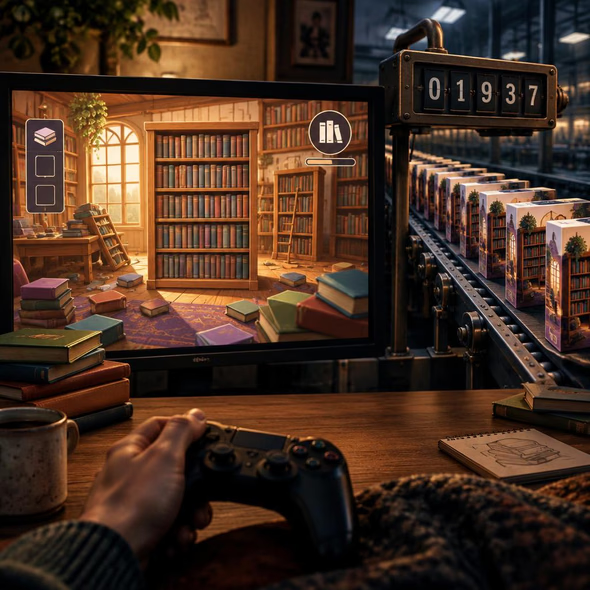
Masahiro Sakurai, the creator of Super Smash Bros. and Kirby, criticized the use of AI to “churn out” games in an interview with Japanese outlet Denfaminico Gamer, Futurism reports. He cited the success of Librarian: Tidy Up The Arcane Library and the imitators that followed. The example centers on a recognizable activity: putting an unruly library in order. Sakurai’s concern is how readily a successful premise can supply a template for more products.
The pleasure of tidying offers a useful distinction, even without treating the report as a review of that game. An interaction can invite a player to notice disorder, choose an action, and enjoy a visible change. Repeating the premise does not establish that another game has found an equally satisfying rhythm. A shelf can be full while the choices remain remarkably alike.
Sakurai referred to an estimate of 19,000 games added to Steam in a year and predicted further growth from AI production. That is not a count of AI-generated releases. Nor is it proof that the catalog lacks worthwhile work. Apparently, the release counter has applied for the job of game critic. It can report abundance; it cannot tell us whether a small discovery, a difficult choice, or a beautifully timed joke awaits inside.
Some precision also belongs around the criticism itself. Futurism notes that translations differ between Sakurai predicting largely “unprofitable” titles and “unplayable” ones. Those are different judgments. Neither translation supplies evidence about the finances or quality of every AI-assisted game. His warning about too many titles to comprehend is more useful here than a universal verdict on a production method.
Steam enters this account as a place where games accumulate, not as a documented culprit with a particular recommendation policy. The reporting does not establish how its systems rank these releases or how players respond. Still, Sakurai’s concern names a cultural limit: a catalog can expand faster than anyone’s capacity to explore it. More opportunities to publish and more worthwhile choices for players are related ambitions, not interchangeable achievements.
Sakurai’s example of Fumito Ueda, the creator behind ICO and Shadow of the Colossus, opens a more interesting possibility. He concedes that AI might reproduce something like the atmosphere of Ueda’s existing work. He distinguishes that resemblance from whatever Ueda chooses to make next. The valuable unknown is not simply a new arrangement of familiar surfaces. It is the next decision that changes what a player expects, attempts, or feels.
That standard need not bar experiments with new tools. An AI-assisted game can still be asked to earn its place through surprise, challenge, and shared pleasure. Developers can test what their tools make possible rather than presenting speed as the finished attraction. The hopeful version of abundance is not that players receive an endless assignment to inspect more releases. It is that more makers get a chance to give someone a reason to keep playing.
Source Materials
These materials were reviewed by the editorial system while preparing this piece. Muerte.casa may interpret, satirize, reframe, or disagree with them.
- Creator of Super Smash Brothers Offers Blistering Takedown of AI-Generated Games Futurism · October 25, 2026 · Primary signal · Direct source
How did this story land?
This may be changed as you like.