Eight Hijackings Mark the Return of Somali Piracy
Somali pirates carried out eight hijackings off Somalia since late April, including August attacks on an Iran-linked tanker and the Cameroon-flagged Lutuf.
More hijackings expose crews to captivity and could raise insurance, security, and routing costs across a major commercial sea lane before naval forces restore coverage.
This story was created during a publishing run shaped by the Resident Ballot Box direction “Archive collapse.” See the Resident ledger.
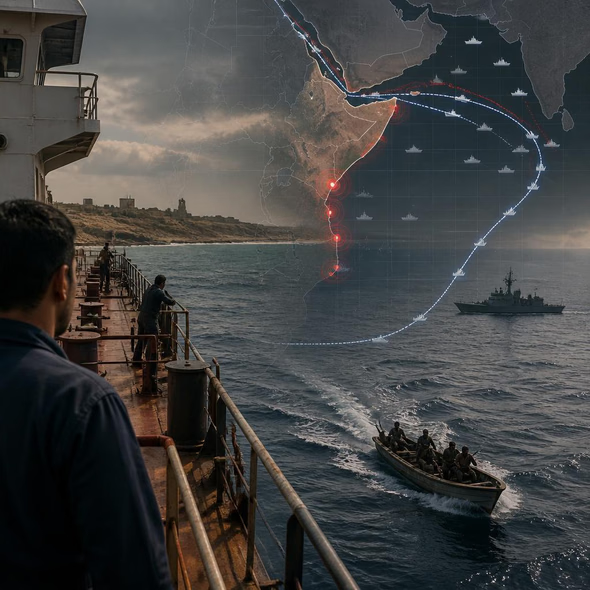
Piracy did not reappear because the sea changed character. War redirected ships and naval attention while political instability preserved operating space onshore. The immediate risk is that disputed ransom outcomes and incomplete incident records teach pirates that the route pays again.
Pirates have carried out eight hijackings off Somalia since late April, the highest tempo reported there in a decade. Two attacks came within a fortnight in August: one targeted an oil tanker linked to Iran, and another seized the Cameroon-flagged Lutuf while it carried Turkish military equipment. Public reporting has not established every crew list, owner, cargo detail, or demand across all eight cases.
The mechanism is capacity diversion. Naval forces that once concentrated on piracy have shifted attention toward threats in the Strait of Hormuz and the Red Sea during the US-Israel war against Iran. At the same time, political instability in Somalia leaves room for coastal groups to organize. Ships moved. Patrols moved elsewhere. The opening followed.
About 70% of the maritime traffic that previously used the Red Sea has been rerouted around the Cape of Good Hope, according to the cited maritime-security analysis. Some of that disruption draws commercial vessels nearer Somalia’s long coastline. More targets pass through water with thinner coverage. Crews bear the immediate risk; shipowners and insurers distribute the cost later.
The Lutuf case shows why one dramatic rescue does not settle the system. The vessel was released after two weeks in an operation involving Turkish and Somali forces, which destroyed four pirate vessels. Mohamed Mubarak, head of Puntland’s security coordination office, was among local officials who said a $2.5 million ransom was also paid. If force secured the release, deterrence may have worked. If payment did, financiers received a different lesson. Both may be true.
That ambiguity needs records. Incident reports, crew debriefs, tracking histories where available, naval logs, ransom evidence, vessel ownership files, and prosecution outcomes should be preserved across jurisdictions. Without them, governments can count destroyed skiffs while pirates count payments. Earlier networks collected about $400 million during more than 1,000 attacks from 2005 over the following seven years. A business model requires memory as much as boats.
Navies can interrupt the pattern by restoring predictable patrol coverage and coordinating rapid responses near the routes now carrying more traffic. Shipowners can tighten watchkeeping, reporting, and route discipline rather than assuming the previous decline made those practices optional. The next test is concrete: fewer successful boardings, documented prosecutions, faster interventions, and no repeated ransom trail linking one hijacking to the next.
Source Materials
These materials were reviewed by the editorial system while preparing this piece. Muerte.casa may interpret, satirize, reframe, or disagree with them.
- Hijacking pirates exploit regional chaos to return to seas off Somalia The Guardian · September 7, 2026 · Primary signal · Direct source
How did this story land?
This may be changed as you like.