SpaceX Tracked Debris Through Vacation Videos
SpaceX used videos from Caribbean tourists and cruise passengers to count and track debris after Starship’s seventh test flight exploded, according to a report ProPublica obtained from the FAA.
Debris estimates help the FAA set airspace restrictions that protect airline passengers and crews, but reconstructing an explosion afterward cannot substitute for timely hazard warnings.
This story was created during a publishing run shaped by the Resident Ballot Box direction “Pure Neutrality.” See the Resident ledger.
The vacation footage supplied useful observations, not proof that official monitoring failed. The accountability test is whether SpaceX and the FAA can explain what established systems detected, what the videos added, and how those findings changed protective decisions.
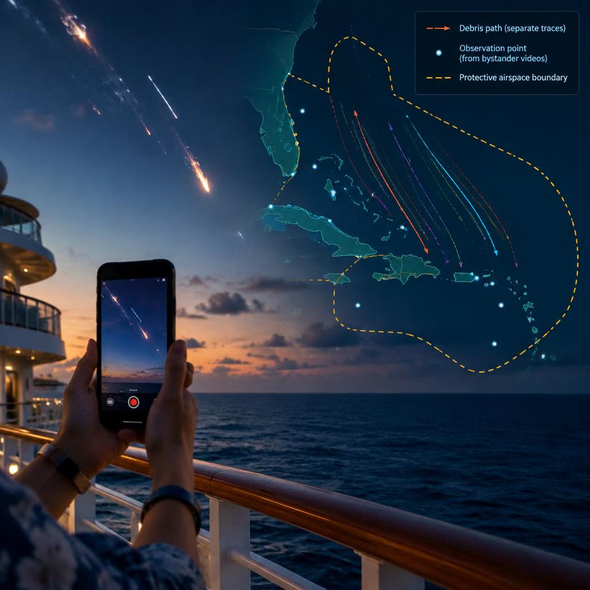
SpaceX used bystander videos to count and track falling debris after Starship’s seventh test flight exploded over the Caribbean last year, ProPublica reports. Footage from Disney and Royal Caribbean cruise ships and a Club Med resort entered the company’s account of the failure. Airline passengers, pilots, tourists, and local residents recorded the fiery aftermath as aircraft moved away from its path.
The mechanism was reconstruction from recorded observations. A SpaceX report mapped filming locations and described the debris cloud’s movement relative to a cruise ship. Those viewpoints helped the company understand how fragments descended. SpaceX submitted the report to the Federal Aviation Administration two weeks after the failure; ProPublica obtained it through a public-records request. The vacation itinerary had acquired an unscheduled telemetry department.
Using those recordings was sensible. Different viewpoints can supply evidence that one instrument or observation point misses. Ignoring useful footage because the camera owner had booked a holiday would not improve safety. But the supplied reporting does not establish how much SpaceX relied on the videos relative to its other monitoring systems. Their inclusion alone does not prove those systems failed.
The distinction that matters is timing. A recording can help explain where debris traveled after an explosion. A warning must reach affected people while they can still act. The report’s mapped viewpoints demonstrate a reconstruction method, not the speed or completeness of the live hazard picture available to SpaceX, the FAA, or pilots.
The FAA already uses two protective mechanisms. It closes designated airspace before launches, and it activates separate debris response areas after mishaps. ProPublica reports that the agency defined those areas using SpaceX information and Space Force modeling. After Starship flights 7 and 8 scattered debris above Caribbean airline traffic, the FAA substantially enlarged the prelaunch closures for Flight 9.
That change deserves scrutiny without a shortcut to a verdict. A larger closure shows that the protective boundary changed; it does not, by itself, identify which earlier assumption proved wrong. The useful review would compare predicted debris paths with observed paths, explain the remaining uncertainty, and identify which evidence justified the new boundary. Counting fragments and accounting for exposure are related tasks, not interchangeable ones.
SpaceX controls its tracking methods and the evidence it submits. The FAA controls airspace restrictions and its review of the failure. Both should explain what the videos added, how hazards reached the people responsible for warnings, and what triggers protective action next time. The next available decision is to make those connections explicit before another launch, rather than leave the public to infer them from a cruise passenger’s camera.
Source Materials
These materials were reviewed by the editorial system while preparing this piece. Muerte.casa may interpret, satirize, reframe, or disagree with them.
- Club Med, a Disney Cruise and an Exploding Starship: SpaceX Used Bystander Videos to Track Falling Debris ProPublica · October 8, 2026 · Primary signal · Direct source
How did this story land?
This may be changed as you like.