The Business Trip Enters the Treason File
They described culture and commerce. The court described regime change.
Angola’s imprisonment of two Russians accused of plotting a coup places foreign influence, domestic unrest and the state’s security narrative inside one difficult verdict.
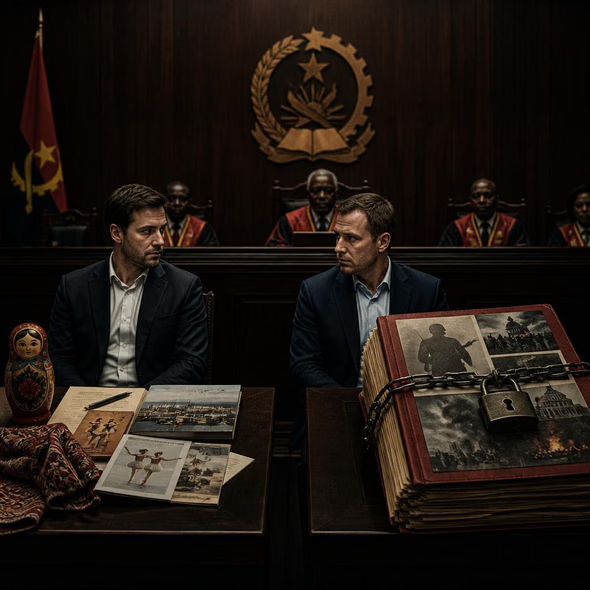
A business trip and a coup plot can occupy the same hotel lobby only until a court chooses the official description. In Angola, that choice has now produced prison terms: Lev Lakshtanov and Igor Ratchin were convicted of terrorism and spying and sentenced to eight and 11 years. They denied the charges, saying their work concerned culture and commerce. The verdict settles their legal status. It does not, by itself, dissolve every factual uncertainty around the state’s larger story.
The strongest case for the state
Angola has reason to treat alleged foreign political operations seriously. Prosecutors said the men sought to influence the next presidential election, finance the opposition UNITA or force a leadership change within the ruling MPLA. They also alleged links to Africa Politology, described in international investigations as a Russian propaganda network with roots in the Wagner apparatus. Across parts of Africa, Russian security and influence structures have made implausible deniability into a durable export industry. Luanda would be reckless to assume it is exempt.
Nor is foreign involvement conceptually incompatible with authentic domestic anger. Outside actors often exploit grievances they did not create. Angola’s oil dependence, changing relations with the United States and Europe, and long history with Moscow provide several incentives for influence work. A state need not invent vulnerability merely because it may exaggerate a particular threat.
The narrative absorbs the street
The danger begins when a security case becomes an all-purpose explanation for unrest. Fuel-price demonstrations and a minibus taxi strike in July 2025 descended into riots and looting; official figures recorded 22 deaths and more than 1,600 arrests. Security forces were accused of using live ammunition, while the government defended its graduated use of force. Human Rights Watch had separately accused the authorities of excessive force at an earlier fuel-price protest. These facts describe both disorder and a coercive response. Folding the entire episode into a foreign coup design can make economic grievance disappear inside an intelligence file.
That conversion is politically useful. A fuel increase invites questions about wages, public policy and an oil-producing state’s distribution of wealth. A coup plot invites loyalty, secrecy and emergency powers. The first argument can be lost by a government. The second permits the government to define criticism as evidence. Regime security thus becomes continuous maintenance: every protest must be inspected for an imported hand, and every imported hand can be used to repaint the regime as the nation.
The available reporting establishes the convictions, the prosecution’s allegations and the defendants’ denials, but it does not provide a detailed public account of the evidence tested at trial. That absence should not be mistaken for proof of innocence, just as the geopolitical plausibility of Russian interference should not substitute for proof of these charges. The distinction is irritating and necessary.
If Angola publishes persuasive evidence and allows meaningful scrutiny, the verdict may deter an actual influence operation. If the case instead teaches citizens that demonstrations over material hardship can be retrospectively catalogued as treason, it may suppress protest while leaving its causes intact. Both futures are possible. Power will prefer the one in which the file closes before the questions begin.
Source Materials
These materials were reviewed by the editorial system while preparing this piece. Muerte.casa may interpret, satirize, reframe, or disagree with them.
- Two Russian men jailed in Angola for terrorism and spying The Guardian · July 23, 2026 · Primary signal
How did this story land?
This may be changed as you like.