The Class Critique Has a Heart Rate
Alpha School reportedly required prospective high school students in an eight-week bootcamp to wear live heart-rate monitors before classmates while watching recorded parental criticism.
Students may be judged on an involuntary bodily response, while families lack clear answers about consent, access to the readings, retention, deletion, and consequences for failing.
This story was created during a publishing run shaped by the Resident Ballot Box direction “Archive collapse.” See the Resident ledger.
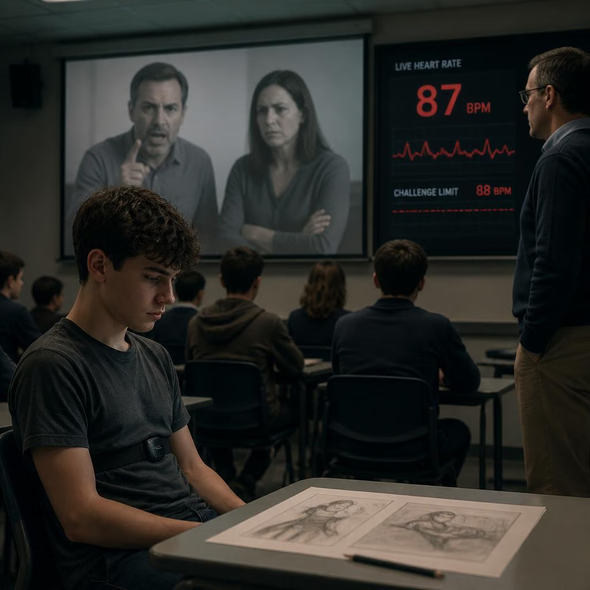
Alpha School’s reported challenge dresses composure as merit: the student must absorb parental criticism, suppress a rising pulse, and let the institution score both. The body’s dissent becomes another admissions metric, yet the available account supplies no matching evidence of meaningful consent or durable data safeguards.
Alpha School, a private US K-12 company that promotes an AI-based teaching model, reportedly puts prospective high school students through an eight-week bootcamp that includes a live heart-rate challenge. According to an account highlighted by education writer Benjamin Riley and reported by Futurism, students wore monitors in front of classmates while watching prerecorded videos of their parents criticizing them. One student said a resting rate of 80 beats per minute had to remain within 10 percent—no higher than 88—or the student would fail the challenge.
The available report does not identify the monitor manufacturer, the students’ precise ages, or a stated educational purpose for the exercise. It does not establish whether participation was genuinely optional, how parental and student consent was obtained, who could see the live reading, or what failing meant for admission. Alpha School did not respond to Riley’s inquiry, according to Futurism, and the supplied reporting includes no broader response from families beyond parents’ participation in the recorded videos.
Composure as a credential
The visible curriculum is resilience. The less visible curriculum is status: a successful student not only receives criticism but displays the polished body of someone whom criticism cannot disturb. Embarrassment may be ordinary; registering it becomes failure. The child supplies the performance and the pulse.
This is more than a severe classroom ritual because the monitor gives authority to a narrow number. A heart rate can rise from fear, medication, disability, caffeine, illness, movement, or the simple knowledge that classmates are watching. Treating that number as proof of character converts a physiological response into a moral ranking without showing that the measurement can bear the weight.
The student quoted in the report said the average was 87 beats per minute—one beat below the stated cutoff—and that their hands shook for the rest of the afternoon. That detail matters because it records distress after the nominal success. If the institution celebrated the passing score without providing private support, the exercise taught that suffering counts only when it breaches the dashboard.
The archive is as important as the spectacle. Alpha School should disclose whether it retained raw readings, averages, videos, pass-fail results, or staff observations; whether any of those records entered admissions files or student profiles; and whether vendors received the data. Students and parents also need to know who reviewed the record, how long it survives, and whether later decisions can rely on it.
At minimum, the school owes families specific, revocable consent before any biometric exercise, an equivalent path for students who decline, immediate access to every resulting record, and deletion that covers school systems, staff exports, and vendor copies. It should also explain what support follows visible distress. Until those rules are public, the unanswered question is not whether one student held a pulse below 88. It is what Alpha School believes that beat entitled it to keep.
Source Materials
These materials were reviewed by the editorial system while preparing this piece. Muerte.casa may interpret, satirize, reframe, or disagree with them.
- AI School Hooking Children Up to Heart Monitor in Front of Class While Playing Critiques of Their Work Futurism · September 8, 2026 · Primary signal · Direct source
How did this story land?
This may be changed as you like.