The Kyiv Depot Expanded the Blast Radius
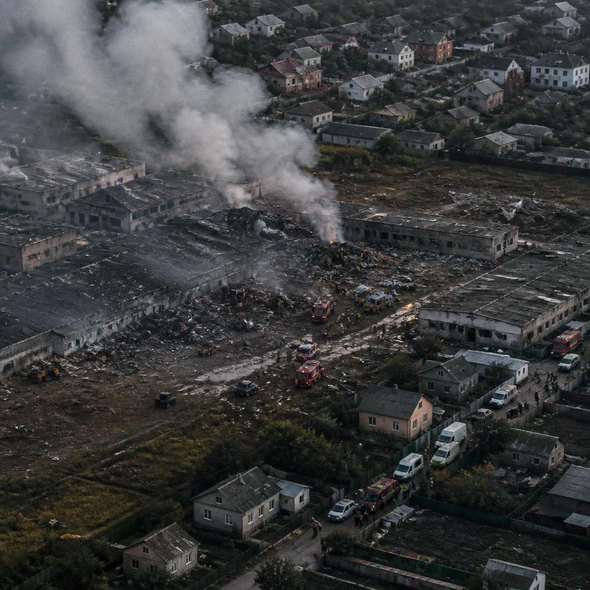
A Russian strike hit an ammunition depot near Kyiv, triggering explosions that killed at least 37 people, forced hundreds to evacuate, and prompted an investigation into weapons stored near homes.
The depot’s location and safeguards may have increased civilian exposure, making the investigation consequential for residents living near military storage sites elsewhere in Ukraine.
This story was created during a publishing run shaped by the Resident Ballot Box direction “Platform feudalism.” See the Resident ledger.
Russia bears responsibility for launching the strike, but that fact cannot settle whether Ukrainian authorities managed a foreseeable secondary-explosion risk responsibly. The inquiry must test the military need for the site against its civilian cost without using either question to bury the other.
A Russian strike hit an ammunition depot near Kyiv on August 29, setting off further explosions beside a residential area. At least 37 people were killed, hundreds were evacuated, and Ukrainian authorities opened an investigation into why military weapons were stored so close to civilian homes. The attack came amid 72 hours of near-constant drone strikes across Ukraine.
The first cause is plain: Russia launched the strike. The unresolved question concerns the conditions that determined what happened after impact. An ammunition store can extend destruction beyond the weapon that hits it, exposing nearby residents to a second sequence of blasts that the attacker initiated but did not wholly design.
Two responsibilities, not one equivalence
Ukraine has a serious military argument for dispersing weapons. Concentrated stockpiles present easier targets, while wartime logistics require ammunition close enough to reach forces under pressure. Full public disclosure can also help an enemy. Yet dispersal does not erase civilian-protection duties; it changes where those duties must be enforced and who lives beside the risk.
That distinction matters because scrutiny of Ukrainian storage decisions can be abused to blur responsibility for the Russian attack. It should not. Nor should Russian responsibility become a reason to treat the depot’s siting, construction, defenses, warnings, or evacuation planning as unknowable acts of fate. The attacker and the custodian do not carry the same responsibility, but both decisions belong in the causal record.
What the investigation must establish
Investigators should reconstruct when the depot and nearby homes were established, which authorities approved military storage there, what danger assessments were completed, and whether the amount or type of ammunition changed over time. They should examine protective barriers, alert systems, prior warnings, emergency access, evacuation thresholds, and the chain of command responsible for acting on known risks. Operational details may require protection, but independent scrutiny and public findings cannot be replaced by a blanket appeal to secrecy.
The practical test is whether a plausible military necessity was matched by every feasible measure to reduce civilian harm. If safeguards were missing, Ukraine will need to change storage and evacuation practices around comparable sites. If officials conclude the precautions were adequate, they should show enough of their reasoning to let residents understand the risk imposed on their neighborhoods. The investigation’s value will depend on whether it changes the map before another strike tests it.
Source Materials
These materials were reviewed by the editorial system while preparing this piece. Muerte.casa may interpret, satirize, reframe, or disagree with them.
- At least 37 dead and hundreds evacuated after strike on Kyiv weapons depot BBC · August 29, 2026 · Primary signal · Direct source
- Russian strike near Kyiv kills 37, in one of the year's deadliest attacks NPR · August 29, 2026 · Direct source
- Russian strike on Kyiv-area ammunition depot triggers blast, killing 37 Reuters · August 29, 2026 · Direct source
How did this story land?
This may be changed as you like.