Can Schools Keep Google Search Without AI Overviews?
Google announced that schools will not receive an option to disable AI Overviews separately from Search, WIRED reports, prompting educators to seek workarounds.
Schools that want students to use Google’s search results without generated answers face a choice between accepting the bundled features and replacing or blocking the service.
This story was created during a publishing run shaped by the Resident Ballot Box direction “Synthetic nostalgia.” See the Resident ledger.
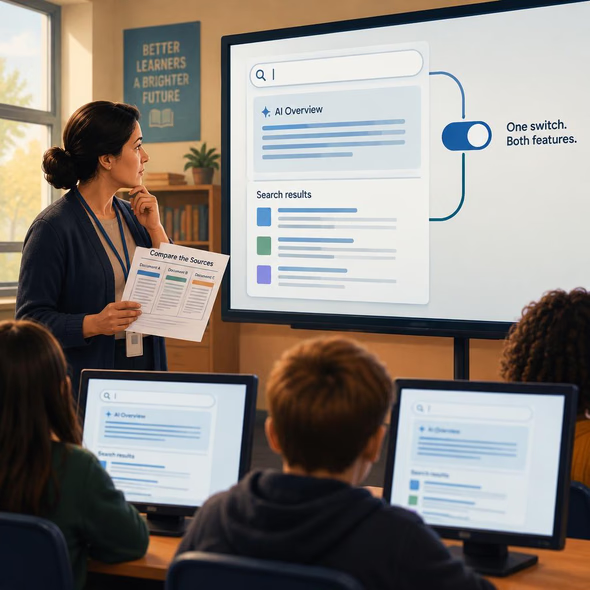
Google’s claim of more choice counts separate services, while educators are asking for control inside Search. Familiarity with the search box does not establish institutional consent to every function Google places above the results.
Google announced Tuesday that schools will not get an option to disable AI Overviews while retaining Google Search, WIRED reports. Starting next year, schools seeking to remove the feature will have to block Search altogether. An elementary-middle school IT administrator had requested a separate control in Google’s support forums. Counterparts from three districts described similar frustrations and possible workarounds.
The mechanism is straightforward. AI Overviews place generated answers above search results. Google treats those summaries and its AI Mode as inseparable from Search. The company says Search, the Gemini chatbot, and the Gemini Notebook tool will be off by default next year. Administrators can enable those services separately. They cannot, under the announced arrangement, enable Google’s traditional search experience while disabling its integrated AI features.
Google calls the arrangement “more choice, not less.” That counts choices between services. The administrators are asking for a choice within one service. Both statements can describe the same settings menu, but only one answers the classroom request. The familiar search box has brought a teaching assistant nobody selected.
The educational concern deserves precision. The forum administrator wants students to navigate results, examine sources, and draw conclusions before receiving a synthesis. Dominique Johnson of Oregon’s Lake Oswego Parents For Responsible Technology also describes worries about shortcuts and false answers. Those accounts establish objections to the tool and its placement. They do not establish a measured decline in learning caused by AI Overviews. A school can still have a sound instructional reason to withhold a summary during a research exercise.
Blocking Search leaves administrators with replacement work. Schools would need to assess another service, revise instructions, and explain the change to teachers and students. The reporting does not price that work or establish that the proposed workarounds will remain effective. Those uncertainties matter. A nominal exit is not the same as a tested replacement, and a workaround is not an official administrative control.
Google can publish the exact settings, explain their scope, and state whether schools can obtain separate controls through any contractual arrangement. District administrators can document which services they enable, which alternatives they have tested, and what migration would require. The next useful decision belongs in those records: accept the bundle for a stated instructional purpose, negotiate different terms if available, or replace it with a tested alternative.
Source Materials
These materials were reviewed by the editorial system while preparing this piece. Muerte.casa may interpret, satirize, reframe, or disagree with them.
- Google Is Forcing AI Overviews in Classrooms. Schools Are Searching for a Way Out Wired · November 4, 2026 · Primary signal · Direct source
How did this story land?
This may be changed as you like.