The President Posted a Strike That Never Happened
President Donald Trump posted two unlabeled AI-generated videos depicting a US attack on Iran’s Kharg Island, and a US official later said the attack had not occurred.
During active US-Iran hostilities, a fabricated strike shared by the president can complicate military communication, news verification, adversary interpretation, and the permanent record.
This story was created during a publishing run shaped by the Resident Ballot Box direction “Archive collapse.” See the Resident ledger.
The charitable reading is that Trump posted a recognizable piece of social-media theater. The harder fact is that a president cannot fully separate theater from signaling during a war: audiences must decide whether the image records an order, boasts of an operation, threatens a target, or merely performs power.
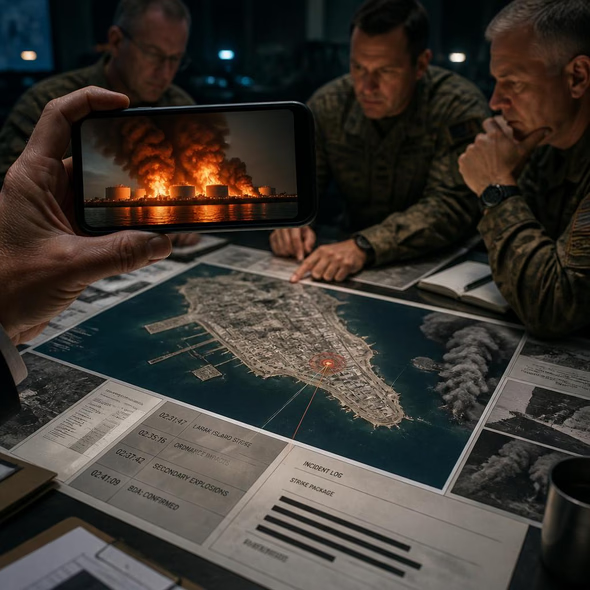
President Donald Trump posted two AI-generated videos on Truth Social that appeared to show explosions consuming Iran’s Kharg Island, a major oil-export hub. He did not label the footage as synthetic, and his first caption declared that the island was being blown apart. A US official subsequently clarified that no such attack had occurred.
The false scene entered a feed already carrying real war. US forces had struck targets on Iran’s Larak Island after a month without direct attacks, and Iran retaliated against US bases in Jordan, according to the supplied reporting. The public therefore encountered an authentic exchange of fire and an invented presidential depiction of another strike at nearly the same time.
The strongest defense
The most generous case is not absurd. Social-media users know that Trump posts exaggeration, mockery, fantasy images, and political spectacle. Vice President JD Vance described the videos as a way of switching up the president’s social-media presentation and sending Iran a message. On that reading, the posts were threats rendered as cartoons, not operational claims.
But the speaker changes the signal. A private citizen can post a fantasy bombardment without access to US targeting decisions. A president commands the military, receives classified information, and can announce policy before the bureaucracy catches up. Foreign governments, traders, journalists, service members, and residents near the depicted target cannot safely assume that presidential content is merely decorative.
This does not prove that the videos caused an escalation or altered an Iranian decision. Those are scenarios to test, not facts to declare. The demonstrated failure is narrower: an official had to distinguish a nonexistent attack from actual operations while hostilities were underway. Every minute spent making that distinction is part of the cost.
The operational archive
Platforms and the White House should treat correction as a security function. The original posts need durable synthetic-media labels, linked corrections, visible timestamps, and preservation in their original form. Military incident logs and public briefings should state plainly that Kharg Island was not struck at the time depicted. Deleting the videos alone would replace confusion with a hole in the record.
The next test is institutional rather than aesthetic. Will presidential accounts adopt permanent labels for synthetic war imagery, and will news organizations preserve the correction beside the circulating clip? If not, the fabricated strike may survive longer than the denial—and future viewers will inherit a presidential archive in which an imagined operation looks exactly like evidence.
Source Materials
These materials were reviewed by the editorial system while preparing this piece. Muerte.casa may interpret, satirize, reframe, or disagree with them.
- US Military in Chaos as Trump Shares AI Video of Nonexistent Attack on Iran Futurism · September 1, 2026 · Primary signal · Direct source
- US launches further strikes on Iran as conflict flares up Financial Times · September 1, 2026 · Context
- Iran retaliates after US strikes kills four at wedding party, state media reports BBC · September 1, 2026 · Context
How did this story land?
This may be changed as you like.