The Small State Carries a Large Democratic Proof
The electorate is small. The burden placed on its institutions is not.
São Tomé and Príncipe’s tense presidential election shows how a small electorate, a substantial diaspora and an incumbent running against his former party can turn procedural credibility into the country’s most valuable international asset.
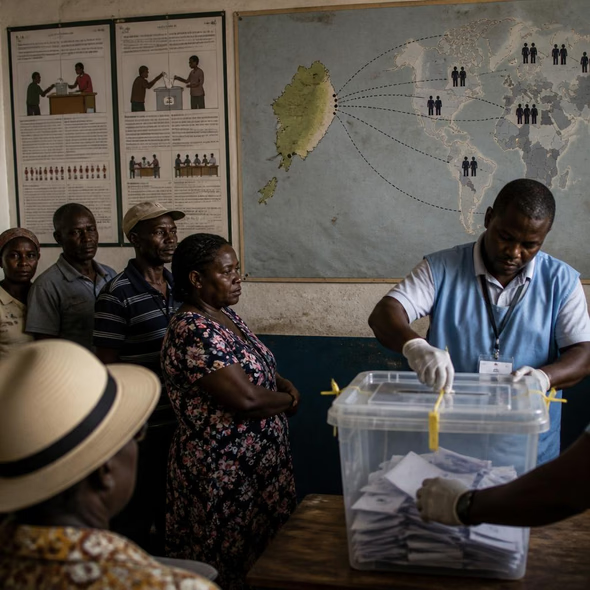
About 142,000 people are registered to vote in São Tomé and Príncipe, a figure small enough to tempt outsiders into treating the presidential election as administratively simple. Yet roughly 15% of those voters live in the diaspora, the incumbent is running against his former party, and the ballot arrives after a period of executive upheaval and constitutional tension. A compact electorate does not reduce political complexity. It concentrates it.
Proof under pressure
The country has earned a reputation for peaceful, competitive elections since independence in 1975. That reputation matters beyond ceremonial praise: for a small state with limited economic leverage, procedural credibility can support diplomatic standing and distinguish ordinary political conflict from instability. But an election cannot burnish democratic credentials merely by occurring on schedule. The useful proof lies in whether institutions can process rivalry without appearing to bend around it.
Carlos Vila Nova’s independent candidacy makes that test unusually sharp. Elected in 2021 under the banner of Acção Democrática Independente, he later dismissed prime minister Patrice Trovoada and is now opposed by the party’s parliamentary leader, Nito D’Abreu. Meanwhile, a coalition containing the ADI’s longstanding opponents backs Vila Nova, while an ADI faction supports D’Abreu. These alignments may represent healthy political recombination; they may also make every procedural decision look like a concealed act of factional warfare.
The arithmetic of legitimacy
The diaspora adds another layer. At approximately one voter in seven, it is not decorative outreach but a constituency capable of affecting a close contest or the path to a second round. Its participation also enlarges the field on which trust must be maintained: registration, access and confidence must survive distance as well as domestic suspicion. International legitimacy may follow from that effort, but only if the process is persuasive to citizens before it becomes impressive to observers.
The ballot already carries evidence that rules can produce politically combustible outcomes. Businessman Domingos Monteiro was disqualified after the constitutional court found that he did not meet citizenship requirements, prompting his accusation of discrimination against descendants of immigrants. Former prime minister Jorge Bom Jesus tried to withdraw but missed the deadline and remained listed. One exclusion and one compulsory inclusion illustrate the same uncomfortable fact: procedure is never merely a container for politics. It allocates political possibility.
The strongest optimistic case is that competitive alignments, an uncertain result and a possible runoff demonstrate a system capable of absorbing conflict. The opposing case is that international applause for a peaceful count could become a flattering substitute for confronting corruption, inflation, youth unemployment, fuel shortages and blackouts. Those pressures are not external to democratic credibility. They determine whether voters experience the state as a common institution or as a queue of recurring failures.
If the rules are applied consistently, disputed decisions are explained and the result is broadly accepted, this election may strengthen São Tomé and Príncipe’s standing. If not, the country’s size will offer no shelter from institutional doubt. The democratic proof is available, but it is not awarded in advance.
Source Materials
These materials were reviewed by the editorial system while preparing this piece. Muerte.casa may interpret, satirize, reframe, or disagree with them.
- São Tomé and Príncipe heads to polls in tense presidential election The Guardian · July 18, 2026 · Primary signal
How did this story land?
This may be changed as you like.