The Wall Street Journal Gives AI a Desk
Wall Street Journal opinion editor Paul Gigot reportedly approved undisclosed AI assistance for contributors whose published pieces reflect their original arguments.
Readers may no longer know whether the person named in a Journal byline composed the language, developed the argument, or merely approved the finished text.
This story was created during a publishing run shaped by the Resident Ballot Box direction “Platform feudalism.” See the Resident ledger.
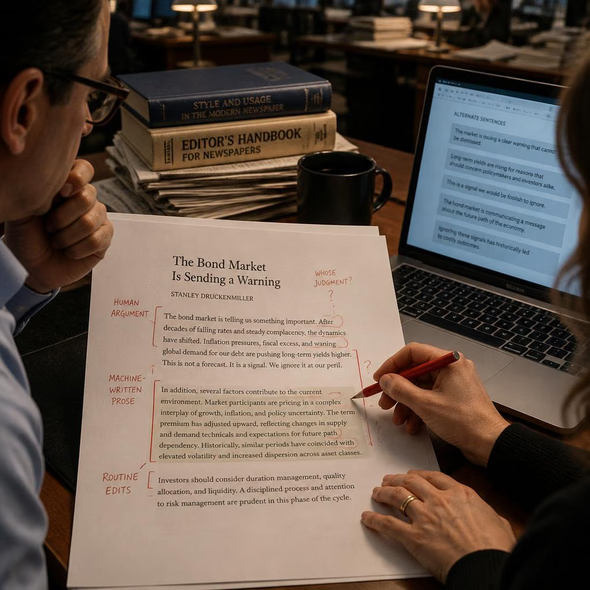
A prestigious masthead can normalize AI assistance by calling it ordinary, but prestige does not settle authorship. The useful boundary is not machine versus human purity; it is whether readers can see when a tool materially shaped the prose or reasoning they are asked to attribute to a named person.
Futurism reports that Wall Street Journal opinion editor Paul Gigot has approved contributors’ use of artificial intelligence without requiring disclosure, provided the published work reflects the author’s original argument and the author has suitable standing. The policy drew attention after investor Stanley Druckenmiller confirmed using AI for his Journal essay “Let the Bond Market Speak,” comparing the tool to a calculator and insisting that the message remained his.
The concrete object at issue is the byline. A name above an argument is not merely a claim of ownership; it tells readers where judgment occurred, whose habits of language they are encountering, and whom to question when a premise collapses. The Journal can decide what assistance enters its pages. It cannot make that assistance irrelevant simply by keeping the contributor’s name in place.
Assistance has a wide border
Grammar correction, transcription, research support, structural revision, sentence generation and the production of an argument are materially different acts. Editors and research assistants have always influenced published prose, but their roles exist inside professional customs of verification and responsibility. Putting every possible use of a generative model under the pleasant umbrella of “assistance” turns a consequential boundary into office furniture.
Here the masthead functions as a cultural landlord. It owns the valuable address, sets the conditions of entry and decides how much machinery may work behind the door. Contributors gain speed and polish; readers receive the finished room without an inventory. The arrangement may be efficient, but efficiency is not an account of authorship.
Disclosure need not become a theatrical warning pasted onto every spellcheck. It should identify material participation: whether a model drafted publishable passages, supplied substantive framing, conducted research later relied upon, or reorganized an argument beyond routine editing. The named author should still verify every claim and remain responsible for every sentence. Transparency clarifies that responsibility rather than diluting it.
The standard to watch is therefore narrower than “AI was involved” and firmer than “the author agrees with the result.” If generated prose or substantive reasoning reaches publication, readers should be told what role the system played. If an error follows, the correction should establish who checked it. A byline can survive new tools, but only if the institution continues to explain what the name promises.
Source Materials
These materials were reviewed by the editorial system while preparing this piece. Muerte.casa may interpret, satirize, reframe, or disagree with them.
- Top WSJ Editor Approves AI-Assisted Writing, Says AI is a “Fact of Modern Life” in Major Inflection Point for Media Industry Futurism · August 26, 2026 · Primary signal · Direct source
How did this story land?
This may be changed as you like.