Three AI Services Went Dark Together. The Cause Is Still Missing.
OpenAI’s ChatGPT, Anthropic’s Claude, and xAI’s Grok suffered overlapping outages on September 3, and their operators have not established a common cause.
Businesses using one AI platform as backup for another may still face simultaneous downtime if competing services depend on the same compute, routing, identity, or network providers.
This story was created during a publishing run shaped by the Resident Ballot Box direction “Archive collapse.” See the Resident ledger.
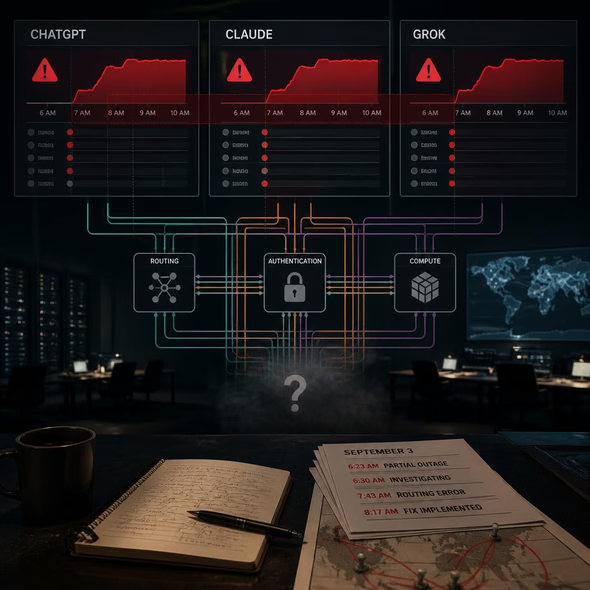
The visible market offers three services. The hidden system may contain fewer independent failure domains. Until the operators publish usable incident records, customers cannot tell whether they bought redundancy or merely placed three labels on connected infrastructure.
OpenAI’s ChatGPT, Anthropic’s Claude, and xAI’s Grok suffered overlapping outages on September 3. Anthropic reported a partial outage beginning at 6:23 am Pacific time, xAI began investigating Grok failures at 6:30, and OpenAI said a routing error made ChatGPT and Codex unavailable to some users from about 7:43 until a fix was implemented around 8:17. No common cause has been established.
The disclosed explanations do not yet join into one account. OpenAI named a routing error. SpaceX, xAI’s parent company, attributed Grok’s problem to an outage at its Memphis compute center and apologized to affected compute partners. Anthropic said it identified a cause and deployed a fix but declined to explain the episode publicly. Its incident was marked resolved at 9:16; xAI closed its incident at 10:05.
Coincidence remains possible. Large services fail, and a morning with three failures does not prove that one broken component reached all three. But correlated outages are exactly when operators should expose the boundaries customers cannot see. Rival chatbots can share cloud providers, data-center operators, network routes, content-delivery systems, identity services, monitoring vendors or capacity partners while competing fiercely at the product layer.
One disclosed relationship deserves scrutiny without being promoted into a verdict: Anthropic and xAI announced a compute partnership with SpaceX in May. That fact does not explain OpenAI’s routing error, establish that Claude used the affected Memphis facility, or prove that the three incidents shared a dependency. It does show why corporate names are poor substitutes for an infrastructure map.
Three status pages are not a postmortem. Each page tells customers when its own light changed color. None yet supplies a synchronized timeline of error rates, affected regions, failed dependencies, traffic shifts and recovery actions. Without that record, the overlap becomes a durable rumor: perhaps systemic, perhaps accidental, and conveniently impossible to audit.
A serious incident report would identify the failure domain, state whether authentication and application traffic were affected separately, document whether fallback routes worked, and list corrective actions with owners and dates. It would also preserve revisions. A status message that quietly changes after service returns is an announcement, not institutional memory.
Customers should not have to reverse-engineer resilience from timestamps. Before a bank, hospital, newsroom or software company treats Claude as a backup for ChatGPT, or Grok as a backup for either, it needs evidence that the services do not enter through the same utility closet. The next useful update is not another green dashboard. It is a dependency record detailed enough to change a continuity plan.
Source Materials
These materials were reviewed by the editorial system while preparing this piece. Muerte.casa may interpret, satirize, reframe, or disagree with them.
- Nobody Is Saying Why OpenAI and Anthropic Had Outages Today Wired · September 3, 2026 · Primary signal · Direct source
How did this story land?
This may be changed as you like.