Toby Shang Knows a Crowd Is Not a View Count
The Guardian profiles Toby Shang, whose University of Lagos presentation earned his nickname, and the performers developing the Afrobeats offshoot called Afrohype or lamba.
Treating hype as musical labor makes performers’ timing and microphone control visible, while view counts alone cannot establish how well they engage a live audience.
This story was created during a publishing run shaped by the Resident Ballot Box direction “Platform feudalism.” See the Resident ledger.
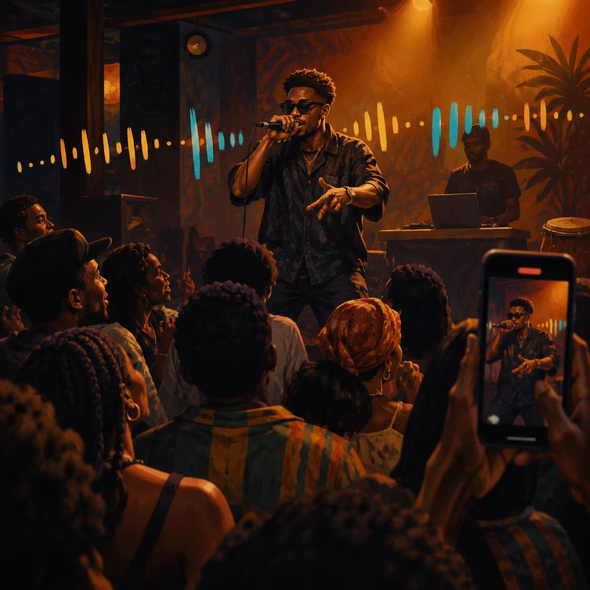
Shang’s career suggests that a circulating catchphrase and a responsive room are related achievements, not interchangeable ones. Digital recognition can carry the work further without supplying a complete measure of its skill or pleasure.
At the University of Lagos in 2015, a first-semester history presentation earned Tobi Michael Adeyeye a name that outlasted the assignment. His classmates began calling him Toby Shang after the dynasty he discussed, the Guardian reports. The future emcee had already practiced holding attention as a high-school band’s ginger-man, or energizer, and as a private tutor. Before the catchphrase traveled, someone had to make a class listen.
By his final university year, Shang’s viral phrases and performance energy had helped produce the hit Shedibalabala. Now 32, he describes himself as one of the pioneers of an Afrobeats offshoot called Afrohype or lamba. His work has expanded into two EPs, his own rave, and four editions of a School of Hype, a one-day masterclass with online mentoring. These are different forms of cultural work, not merely additional places to advertise the same personality.
The Guardian describes performers laying ad-libbed vocals and onomatopoeic sounds over beats and familiar instrumentals. Cultural critic Dami Ajayi singles out microphone control and the quips placed between lyrics. That interval matters: the emcee works inside music people may already know, finding space for another voice without simply replacing the song. The engagement strategy has lungs. More precisely, it has timing, phrasing, and a person deciding when to enter.
Calling all this promotion confuses a function with an art. A performer can publicize a party and also help make the party worth attending. The reported nightclub response includes patrons donating or spraying money, the Nigerian celebratory practice of throwing or placing money on someone. That response is not a complete measure of artistic merit, either. But it makes an exchange visible: the performer offers a vocal intervention, and people in the room answer through a shared custom rather than merely registering another play.
There is no reason to make the room innocent and the screen corrupt. Ajayi also describes quips he heard at a party as risqué and misogynistic; live command does not excuse the material used to achieve it. Meanwhile, the Guardian notes a teenage Instagram performer recording 30-second birthday hypes requested by friends or relatives. A short digital performance can serve a specific social pleasure. Its brevity does not make it counterfeit, just as a crowded dance floor does not certify good judgment.
The distinction is between kinds of attention, not worthy and unworthy audiences. A catchphrase can travel farther than its maker and bring new listeners back to the work. A live performance asks something else: how a voice changes the experience of people sharing time and music. Shang’s career leaves room for both achievements. Digital reach can introduce the performer without becoming the final authority on what the performer gives.
Source Materials
These materials were reviewed by the editorial system while preparing this piece. Muerte.casa may interpret, satirize, reframe, or disagree with them.
- Hilarious quips and ‘100,000-volt’ energy: the hypemen (and women) redefining Afrobeats music The Guardian · October 18, 2026 · Primary signal · Direct source
How did this story land?
This may be changed as you like.