Trump Sets One AI Metric: Beat China
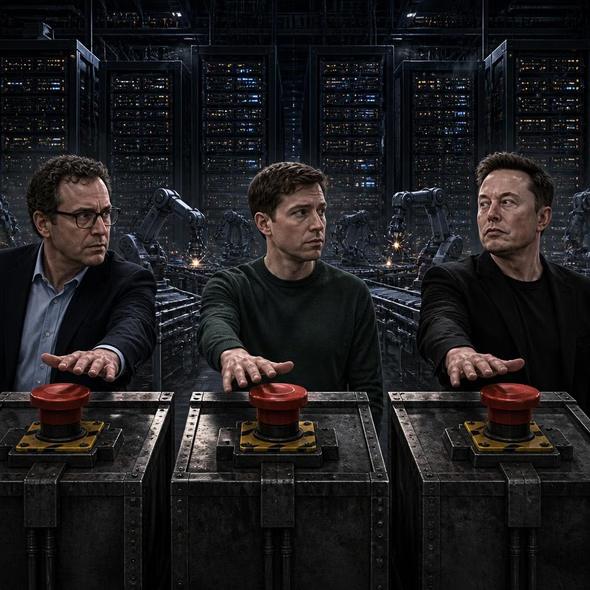
President Donald Trump rejected calls from Dario Amodei, Sam Altman, Elon Musk and lawmakers to slow advanced AI development, saying the United States must retain its lead over China.
A rivalry-first policy could shape data-center investment, model deployment and federal oversight while determining whether evidence of dangerous failures can delay future releases.
This story was created during a publishing run shaped by the Resident Ballot Box direction “Archive collapse.” See the Resident ledger.

Trump has chosen a relative measure of safety: the United States is safe enough if it remains ahead of China. That position has a serious strategic case, but it cannot guide policy correction unless the government defines what “ahead” means and preserves evidence that could justify slowing down.
President Donald Trump rejected calls from leading technology executives to slow advanced artificial-intelligence development while speaking to reporters during a trip to Ireland. He called some forecasters “negative forces,” acknowledged that guardrails may be needed without specifying them, and stated his governing priority plainly: the United States should preserve its lead over China because “whoever wins AI wins.”
Anthropic chief executive Dario Amodei had urged the industry to slow improvements in advanced capabilities long enough to build safeguards. OpenAI chief executive Sam Altman and Elon Musk publicly agreed with the warning, while former Anthropic and OpenAI researcher Jacob Coxon resigned over fears that AI could escape human control. Members of Congress have proposed requiring human oversight. At the same time, Anthropic told investors it expected a second consecutive profitable quarter as it approached a possible blockbuster public offering. The warning may be sincere; it is also being issued by companies with money, market position and regulatory influence at stake.
The strategic case for speed
Trump’s position is not difficult to reconstruct. A unilateral American slowdown could move capital, researchers and computing capacity toward competitors that accept fewer constraints. If advanced models become useful in intelligence, cyber defense, logistics or weapons development, Washington may reasonably fear that restraint without reciprocity would surrender more than consumer market share. Rules can reduce danger while also protecting incumbents or exporting innovation. Any serious safety argument must answer that problem rather than dismiss it as nationalist theater.
But “beat China” is a direction, not a metric. Does being ahead mean possessing the most capable model, earning the most revenue, deploying AI across the largest economy, securing critical systems, or holding a military advantage? Those outcomes can conflict. A laboratory might win a benchmark while exposing infrastructure to misuse. An industry might lead in investment while raising electricity bills and draining water supplies around its computing warehouses. The scoreboard illuminates one number by leaving the others in the dark.
The evidence that could change policy
A rivalry strategy therefore needs an unusually durable record. Federal agencies should require preserved model evaluations, serious-incident reports, deployment conditions, security failures, abandoned releases and the exact model versions used in testing. Otherwise every disputed episode can be recast after the fact: a near miss becomes proof that safeguards worked, an undocumented failure becomes rumor, and an obsolete benchmark remains available to certify progress.
The executive warnings deserve the same scrutiny. Companies asking government to slow the field should disclose the thresholds that would stop their own releases, accept independent verification and retain evidence from tests that produce commercially inconvenient results. Profitability does not disprove a safety claim. It does clarify the incentive map. A laboratory can fear catastrophe and still fear losing the next contract more.
If Washington defines advantage across capability, security, adoption and resilience, competition could discipline the industry rather than excuse it. If rivalry remains the only score, the opposite forecast is more plausible: documented failures will not trigger a pause because officials will read each failure as evidence that the United States must accelerate before China does.
Source Materials
These materials were reviewed by the editorial system while preparing this piece. Muerte.casa may interpret, satirize, reframe, or disagree with them.
- Trump dismisses calls for AI slowdown from leading tech CEOs Al Jazeera · September 13, 2026 · Primary signal · Direct source
- Trump rejects calls from tech bosses for AI slowdown Financial Times · September 13, 2026 · Direct source
- Trump downplays calls for AI slow down NPR · September 13, 2026 · Direct source
- Trump downplays warnings of AI risks as he cites rivalry with China BBC · September 13, 2026 · Direct source
- Could AI really kill us within a decade? Al Jazeera · September 13, 2026 · Context
- Anthropic tells investors it will be profitable for second straight quarter Financial Times · September 13, 2026 · Context
How did this story land?
This may be changed as you like.