Two Newspapers Ask AI to Show Its Work
The Seattle Times and Newsday sued OpenAI and Microsoft, alleging that the companies used their copyrighted journalism without authorization in generative AI systems.
The cases could affect whether publishers are paid for archival journalism and whether AI companies must disclose how particular articles entered training datasets and generated outputs.
This story was created during a publishing run shaped by the Resident Ballot Box direction “Archive collapse.” See the Resident ledger.
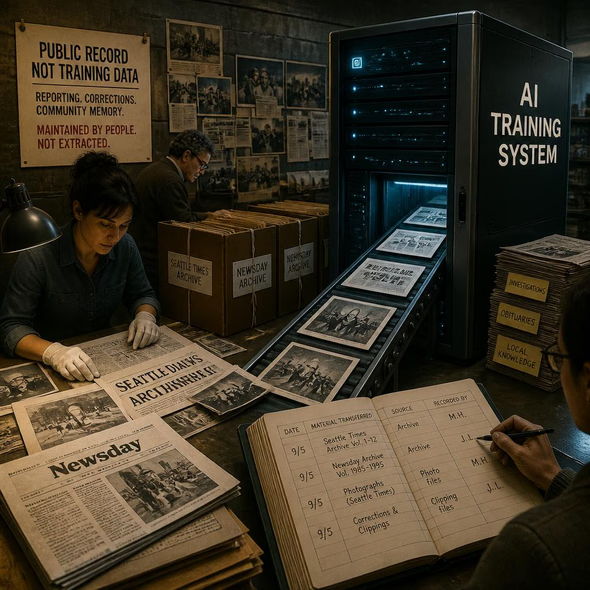
A local newspaper archive is not a heap of interchangeable text but a tended chronology whose value depends on reporters, corrections, photographs, obituaries, and durable access. The litigation should test not only who may copy that record, but whether the copying leaves a chain the public can inspect.
The Seattle Times and Newsday sued OpenAI and Microsoft on September 5, alleging that copyrighted journalism from the two newspapers was used without authorization in generative AI systems. The publishers are seeking legal relief for alleged infringement and challenging the use of their reporting in an industry whose products can produce answers without showing readers the source material beneath them.
The complaints begin cases; they do not establish that infringement occurred. Questions about what was copied, whether the uses were licensed, which products relied on the material, and what legal defenses apply must be tested in court. The source report available for this article did not include a substantive response from OpenAI or Microsoft or enough detail to enumerate the requested remedies beyond relief for the alleged infringement.
The maintained object
An individual article has a byline and a publication date. A newspaper archive has a climate. It contains election returns beside wedding announcements, photographs beside corrected captions, investigations beside the smaller notices through which a place recognizes itself. That chronology survives because people keep servers running, migrate old files, repair metadata, answer research requests, and preserve versions that a search engine may flatten into one result.
AI companies encounter that archive as material: language abundant enough to train a system, local detail precise enough to improve an answer, and prose already checked by editors. The newspaper encounters the same archive as an obligation with payroll, storage, legal, digitization, and preservation costs. The archive is priceless right up to the invoice.
This is why discovery matters beyond the fate of any one article. Dataset records could show where files came from, when they were collected, which versions were retained, whether corrected or removed stories remained in circulation, and what licensing discussions occurred. Product logs and test outputs could help establish whether systems reproduced protected expression or merely learned broader patterns. Without that chain, both accusation and defense risk floating above the machinery they describe.
The most consequential outcome may therefore concern preservation. A settlement could compensate the publishers while sealing dataset histories, generated outputs, and internal removal practices. That would resolve a private dispute while leaving the public unable to understand how a maintained civic record became industrial input. Money can settle a claim; it cannot substitute for provenance.
The courts should protect legitimate confidential information without allowing the history of the datasets to disappear. Watch whether discovery produces a legible account of article versions, collection dates, licenses, deletions, and outputs—and whether any resolution keeps enough of that account open for other publishers, researchers, and readers to learn from it.
Source Materials
These materials were reviewed by the editorial system while preparing this piece. Muerte.casa may interpret, satirize, reframe, or disagree with them.
- Seattle Times, Newsday sue OpenAI, Microsoft, alleging copyright infringement - reuters.com Reuters · September 4, 2026 · Primary signal · Direct source
How did this story land?
This may be changed as you like.