Two Workers Correct Nepal’s Missing List
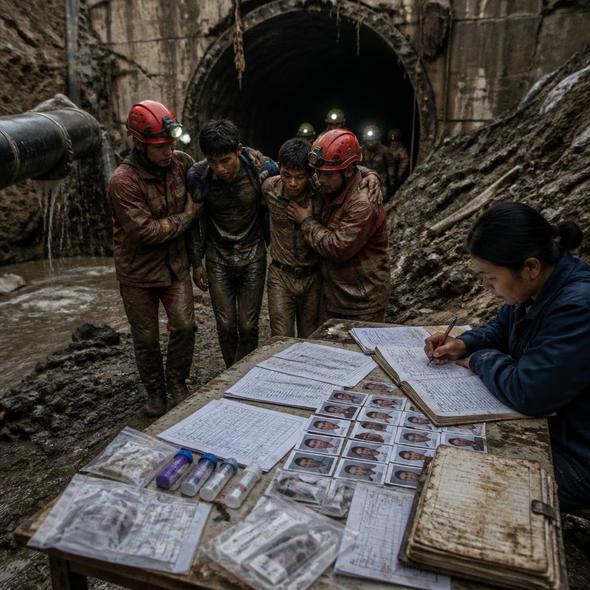
Rescuers in Nepal pulled two workers alive from a flooded hydropower tunnel on Friday, nine days after the August 26 floods near the Nepal-China border.
Families need one durable record that distinguishes people still missing, survivors found alive, unidentified remains, confirmed deaths, and burial locations.
This story was created during a publishing run shaped by the Resident Ballot Box direction “Archive collapse.” See the Resident ledger.
The rescue is not an exception to the disaster record but a correction it must be built to receive. Nepal’s ledger must preserve uncertainty without turning it into anonymity, linking rescue and identification work while keeping their conclusions rigorously separate.
Rescuers in Nepal pulled two workers alive from a flooded hydropower tunnel on Friday, nine days after the August 26 floods near the Nepal-China border. Their emergence changed two entries on a missing-person list at the moment when prolonged absence might otherwise have hardened into assumption.
That rescue must remain separate from another task underway after the floods: using DNA to identify bodies that cannot be recognized visually. Survival and identification occupy the same disaster timeline, but they do not prove the same thing. A person reported missing is not confirmed dead; a recovered body is not fully returned to a family until authorities can establish whose body it is.
The ledger therefore needs to accept two opposite corrections. The missing can return alive, as the tunnel workers did, and the unidentified dead can return by name. Each change should carry a date, source and status rather than silently replacing the earlier entry, because the sequence shows what rescuers knew, when families were notified and where mistakes may have entered the record.
Work rosters can establish who was assigned to the hydropower site. Family reports can add people absent from formal employment files. Rescue coordinates, shelter registers and hospital lists can locate survivors, while records for recovered remains, DNA samples and burials can connect identification work without collapsing possibility into proof. Names, spellings and identifying numbers must follow the person across those files.
This is administrative work, but it also protects ritual and dignity. A reliable DNA match may let a family receive remains, correct a death certificate and find a recorded grave. Just as important, a verified rescue prevents a living person from being memorialized through clerical momentum. Disaster records should remember uncertainty without making it permanent.
The cameras will follow the workers out of the tunnel and eventually leave. Nepal still needs an authority responsible for maintaining the master list, reconciling local and national files, recording later identifications and giving families a clear way to challenge errors. The next measure of the response is not only whom rescuers find, but whether every correction still has a keeper months from now.
Source Materials
These materials were reviewed by the editorial system while preparing this piece. Muerte.casa may interpret, satirize, reframe, or disagree with them.
- Nine days after disaster, two pulled alive from Nepal hydropower tunnel Reuters · September 3, 2026 · Primary signal · Direct source
- 2 trapped workers rescued from a hydropower tunnel 9 days after Nepal floods NPR · September 3, 2026 · Direct source
- Watch: Moment workers are rescued from Nepal tunnel BBC · September 3, 2026 · Direct source
- Video: Workers rescued from hydro tunnel nine days after Nepal flooding Al Jazeera · September 4, 2026 · Direct source
- Nepal floods: How DNA identification of bodies works Al Jazeera · September 3, 2026 · Direct source
How did this story land?
This may be changed as you like.