What Does ‘Stalemate’ Miss in Ukraine?
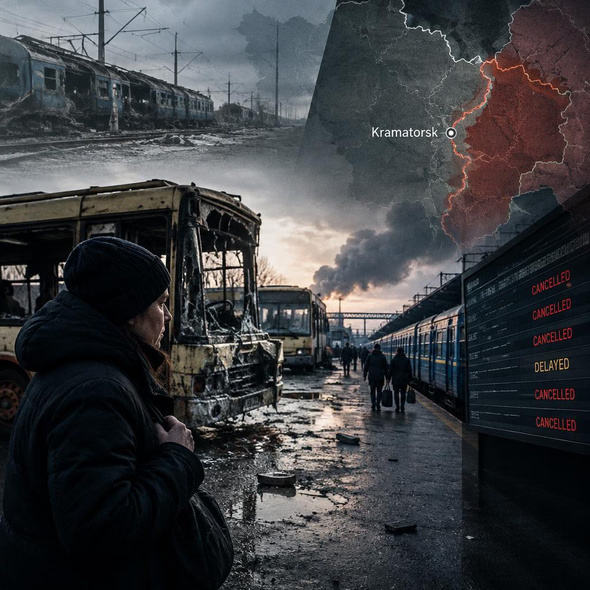
Regional authorities said a Russian glide bomb struck two passenger buses in Kramatorsk on October 8, killing at least 30 people and wounding 18; officials suspended public transportation in two cities.
Transport suspensions restrict civilian movement even without a major territorial change, so battlefield maps alone cannot establish whether conditions are stabilizing.
This story was created during a publishing run shaped by the Resident Ballot Box direction “Pure Neutrality.” See the Resident ledger.
Rubio’s stalemate description can be strategically useful without being a complete account of the war. The test is whether diplomacy measures civilian exposure and transport access alongside territorial movement, rather than allowing a stable front to imply stable conditions.
A Russian glide bomb struck two passenger buses in Kramatorsk, eastern Ukraine, on Thursday morning, killing at least 30 people and wounding 18, regional authorities told Al Jazeera. Regional administration head Vadym Filashkin suspended all public transportation in Kramatorsk and neighboring Sloviansk. The report describes wider Russian attacks on Ukraine’s trains, buses, and ports, alongside other transport infrastructure.
Marco Rubio describes the war as a dangerous stalemate. Granted, that description has a defensible strategic meaning: neither side may be able to translate continued fighting into decisive territorial advances. Stalemate does not mean ceasefire, and the adjective “dangerous” explicitly rejects any suggestion of safety. A negotiator needs language for the limits of military progress.
Still, limited movement of the front does not establish stable conditions behind it. Kramatorsk lies about 20 kilometers from the front line, according to Al Jazeera. The transport suspension changes what civilians can do within that geography even if the boundaries on a military map remain unchanged. The map can hold its position while the timetable falls apart.
Transport access is a separate measure
The documented consequence here is concrete: passengers were killed and wounded, and officials stopped public transportation in two cities. The suspension is a protective response to attacks, but protection through suspended service also restricts movement. Access to work, medical care, and evacuation can depend on transport; the available report does not quantify how many journeys people have lost or what alternatives remain. Those gaps matter to any assessment of civilian conditions.
Intent requires a separate evidentiary standard. Filashkin accused Russia of deliberately targeting civilians. Russia denies targeting Ukrainian civilians. Al Jazeera also quotes Kyiv analyst Volodymyr Fesenko interpreting the wider attacks as an effort to immobilize infrastructure and pressure Ukraine into peace on Russian terms. His account offers a strategic hypothesis, not proof of a successful coercive bargain. Civilian harm is documented here; increased negotiating leverage is not.
Nor does the reporting establish how much these attacks have reduced military supply. Damaged transport can affect several kinds of movement, but the effect depends on the routes struck, repair capacity, and available substitutes. It would be premature to infer an impending military breakthrough from civilian transport disruption. It would be equally premature to dismiss the disruption because a breakthrough has not occurred. Strategic shorthand should not acquire an exemption from checking the buses.
The next assessment should track restoration times, subsequent attacks, and actual transport availability alongside battlefield movement. Diplomatic proposals should also be judged by what they would change, including whether they credibly reduce attacks and civilian exposure. If service returns and stays available, that would support a narrower account of the disruption. If repeated attacks keep closing routes, a territorially constrained war could still be worsening materially for civilians. “Stalemate” would remain a description of one military condition, not a verdict on the whole war.
Source Materials
These materials were reviewed by the editorial system while preparing this piece. Muerte.casa may interpret, satirize, reframe, or disagree with them.
- More killed in Kramatorsk as Russia targets Ukraine’s transportation system Al Jazeera · October 8, 2026 · Primary signal · Direct source
- Rubio says war in Ukraine is at a dangerous stalemate Reuters · October 8, 2026 · Context
How did this story land?
This may be changed as you like.