Washington Cuts Five Diplomatic Posts
The US State Department notified Congress that it plans to close posts in Winnipeg, St George’s, Nagoya, Medan and Douala on cost grounds.
The closures could reduce consular access, local relationships and regional knowledge while testing whether distant hubs can provide the same service.
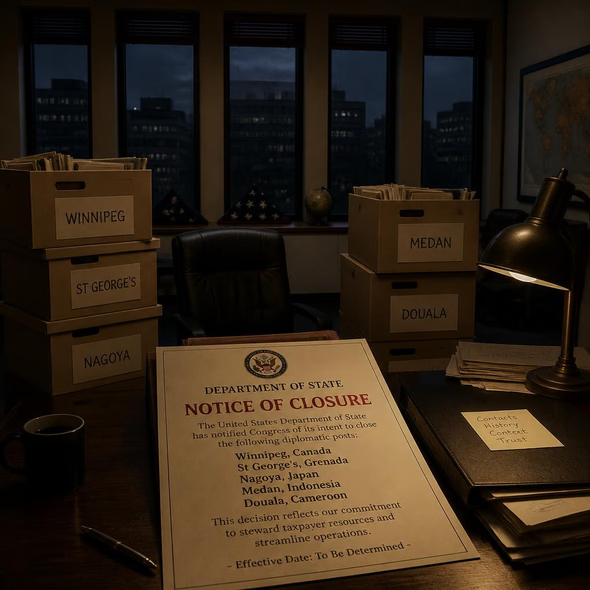
Consolidation has a credible fiscal case, but its advocates must count more than leases and payroll. A diplomatic post is also a store of access and local memory. Claims that China will fill every gap remain unproven; service delays and competing engagement will provide the test.
The US State Department has notified Congress that it plans to close five diplomatic posts: Winnipeg in Canada, St George’s in Grenada, Nagoya in Japan, Medan in Indonesia and Douala in Cameroon. The department has justified the proposed closures on cost grounds as Secretary of State Marco Rubio continues a wider reduction of the department’s operations.
The strongest case for consolidation is not absurd. Governments inherit offices whose original purpose may have weakened, and regional hubs can combine administration, security and specialist staff. A post should not remain open forever simply because closing it produces criticism. The relevant question is whether its work can actually travel with the files.
Some of it can. Reporting can be transmitted, appointments redistributed and senior officials dispatched from an embassy when necessary. But physical posts also accumulate relationships with local government, business and civic institutions. Their employees know which telephone call receives an answer, which dispute has a history and which formal reassurance conceals a practical refusal. That memory rarely appears as an asset on the closure ledger.
The Winnipeg consulate, opened in 2001, has supported trade and investment work focused on Manitoba. Its closure has drawn criticism during a period of US tariffs on Canadian goods. That does not prove the office must survive, but it sharpens the test: Washington is proposing less local contact at a moment when its economic policy creates more need for explanation and repair.
Democratic Senator Jeanne Shaheen argues that China could exploit the withdrawal, noting that Beijing has a presence in three of the five locations. This is a strategic warning, not a guaranteed sequence. China does not automatically inherit every relationship the United States neglects, and local governments are not empty rooms awaiting the next flag. Still, regular access creates opportunities that occasional visits from a regional capital may not match.
The evidence will arrive after the savings announcement: longer waits for consular service, fewer meetings beyond national capitals, weaker commercial access or expanded Chinese engagement in the affected cities. If none of those appears, consolidation will look defensible. If they do, the five closures will demonstrate an old budgetary trick—pricing the office while leaving the lost reach off the invoice.
Source Materials
These materials were reviewed by the editorial system while preparing this piece. Muerte.casa may interpret, satirize, reframe, or disagree with them.
- US to shut five consulates as critics fear China could fill diplomatic vacuum The Guardian · August 6, 2026 · Primary signal · Direct source
How did this story land?
This may be changed as you like.