What Does a Secret Execution Cost?
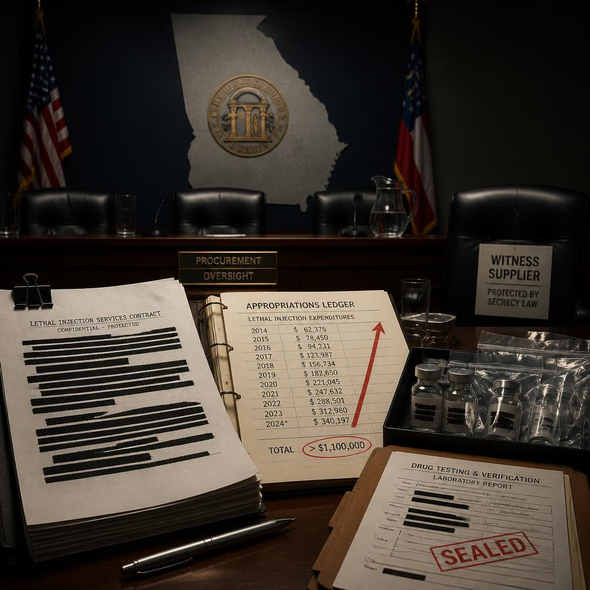
Georgia paid more than $1.1 million since the COVID-19 pandemic for at least one lethal-injection contractor while its secrecy law concealed participants’ identities.
Hidden vendors, services, and prices make it harder for taxpayers and courts to test the cost, quality, and legality of an irreversible state procedure.
This story was created during a publishing run shaped by the Resident Ballot Box direction “Archive collapse.” See the Resident ledger.
Georgia has a legitimate interest in protecting workers from harassment, but secrecy also strengthens scarce suppliers and weakens outside review. The defensible boundary protects people, not the state’s prices, drug provenance, testing, or procurement decisions.
Georgia has paid more than $1.1 million since the COVID-19 pandemic for at least one contractor working with the Department of Corrections on lethal injections, ProPublica reported. The state carried out one execution during that period. Over the past decade, the department averaged more than $150,000 a year in lethal-injection-related spending, substantially above the amounts it had agreed to pay before 2017.
Those figures emerged after ProPublica reporter Joaquin Sapien sued Georgia for records about who had replaced prison physician Carlo Musso in execution work. A three-judge panel sided with Sapien, and the state released some documents. Georgia nevertheless relies on a secrecy law to conceal the names of people involved in lethal injections, arguing that disclosure could expose them to harassment by death-penalty opponents. The records described in the report do not provide a complete public appropriation trail, name every purchasing office, or establish a forward execution schedule.
The case for concealment
The state’s strongest argument is practical. Drug manufacturers, pharmacists, physicians, and other participants may refuse execution work if activists can identify and pressure them. If Georgia is to carry out lawful sentences, officials argue, it must protect the limited pool of willing suppliers and personnel. Confidentiality can therefore be understood as operational security rather than an attempt to avoid scrutiny.
But protection changes the market. When willing contractors are scarce and their identities, terms, and performance remain hidden, they gain leverage over the state while competitors, auditors, prisoners, and taxpayers lose the information needed to challenge a price. The state calls secrecy operational security; the invoice may call it market power. Rising expenditure does not by itself prove abuse, but it creates a stronger reason to inspect what Georgia bought.
The relevant questions extend beyond a contractor’s name. Courts need reliable evidence about drug provenance, composition, storage, expiration, testing, compounding practices, qualifications, and deviations from protocol. Taxpayers need totals, dates, service categories, contract amendments, and the offices authorizing payment. Condemned prisoners and their lawyers need enough information to test claims that an injection could cause extreme pain. Families on every side need confidence that the state is not improvising behind a statutory curtain.
Georgia can protect individual workers while releasing redacted contracts, aggregate compensation, drug lot and testing records, procurement dates, payment approvals, protocol revisions, and conflict-of-interest disclosures. Courts can place genuinely identifying material under protective orders rather than accepting an absent trail. What happens next will show whether the three-judge ruling produced a durable opening or only a partial glimpse: meaningful judicial review depends not on knowing every worker’s address, but on preserving the evidence of what the government purchased, tested, paid, and intends to do.
Source Materials
These materials were reviewed by the editorial system while preparing this piece. Muerte.casa may interpret, satirize, reframe, or disagree with them.
- This State Is Spending More on Lethal Injections. A Law Tries to Keep the Details Secret. ProPublica · September 8, 2026 · Primary signal · Direct source
How did this story land?
This may be changed as you like.