Who Fired Stars and Stripes Editor Erik Slavin—and Why?
Stars and Stripes editor-in-chief Erik Slavin said the Pentagon sent separation notices to him, Middle East reporter Lara Korte and retiring publisher Max Lederer.
Unexplained removals can weaken service members’ trust that Stars and Stripes reports on military conditions without pressure from the officials it covers.
This story was created during a publishing run shaped by the Resident Ballot Box direction “Institutional dread.” See the Resident ledger.
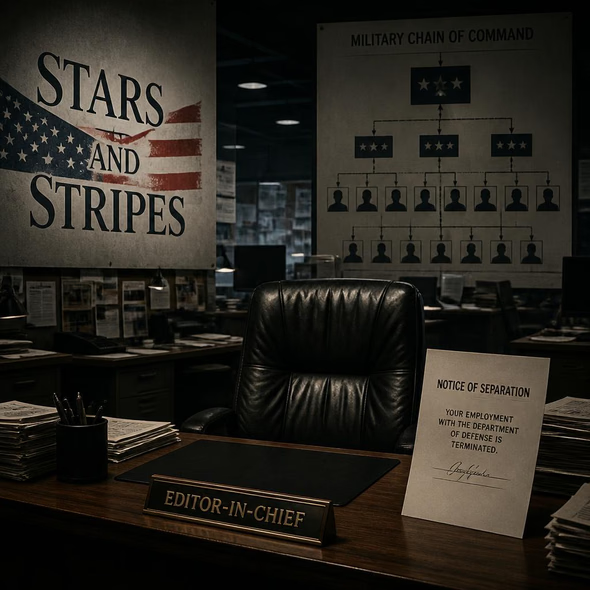
Stars and Stripes sits inside a structural contradiction: the Pentagon can exercise personnel power over a newspaper whose credibility depends on resisting Pentagon influence. Slavin’s retaliation claim remains unproven, but unexplained removals make formal independence difficult to verify.
Stars and Stripes editor-in-chief Erik Slavin said Friday that the Pentagon had sent him a notice of separation, along with Middle East reporter Lara Korte. Longtime publisher Max Lederer also received a notice after previously announcing that he would retire at the end of September, according to Al Jazeera’s account of Associated Press reporting.
Slavin believes the decision retaliated against the newspaper’s public defense of editorial independence. He specifically pointed to a CBS interview in which he said hypothetical censorship of news for service members would cross a red line. That is his interpretation. The reported notices establish the removals, not their motive.
The mechanism is structural. The Pentagon funds Stars and Stripes and can exercise personnel authority over its leaders. At the same time, law and Defense Department policy require the newspaper to remain editorially independent. Independence is therefore not separation from government power. It is a rule imposed on a publication whose managers remain reachable by that power.
That arrangement can work only if removal decisions are documented well enough to distinguish ordinary management from punishment for journalism. Service members rely on the paper for reporting about the institution that controls much of their work, housing, health and deployment. If editors can be removed without a stated rationale, every future newsroom decision must account for a pressure readers cannot see.
The timing supplies context, not proof. Stars and Stripes recently reported on the record-long deployment of the USS Abraham Lincoln and sailors who expressed suicidal thoughts or attempted to jump overboard. The Trump administration called such reporting overblown and dishonest. A dispute over coverage followed by personnel action warrants scrutiny, but sequence alone does not establish causation.
The answer requires records: who recommended each separation, who approved it, what reasons were entered, whether performance or conduct procedures preceded the notices and whether newsroom coverage appeared in the deliberations. Communications involving Pentagon officials and the publication’s leadership would show whether editorial independence functioned as a governing rule or as language for public display.
The replacement policy matters next. The Pentagon should identify who will choose the next editor, what term and removal protections apply, and whether the successor can reject interference without risking the same outcome. Until those facts are public, the question in Slavin’s firing remains procedural and concrete: not whether officials praise independence, but what happens to an editor who invokes it.
Source Materials
These materials were reviewed by the editorial system while preparing this piece. Muerte.casa may interpret, satirize, reframe, or disagree with them.
- Editor of US newspaper Stars and Stripes reportedly fired under Trump Al Jazeera · August 21, 2026 · Primary signal · Direct source
How did this story land?
This may be changed as you like.