Who Gets a Stake in the World Cup?
UEFA asked a US federal court for evidence as it considers a Swiss criminal complaint against FIFA president Gianni Infantino over an abandoned plan involving World Cup commercial rights.
An investor stake could confer leverage over media rights, sponsorship, tournament access, and governance in a competition built by national teams, host infrastructure, and supporters.
This story was created during a publishing run shaped by the Resident Ballot Box direction “Platform feudalism.” See the Resident ledger.
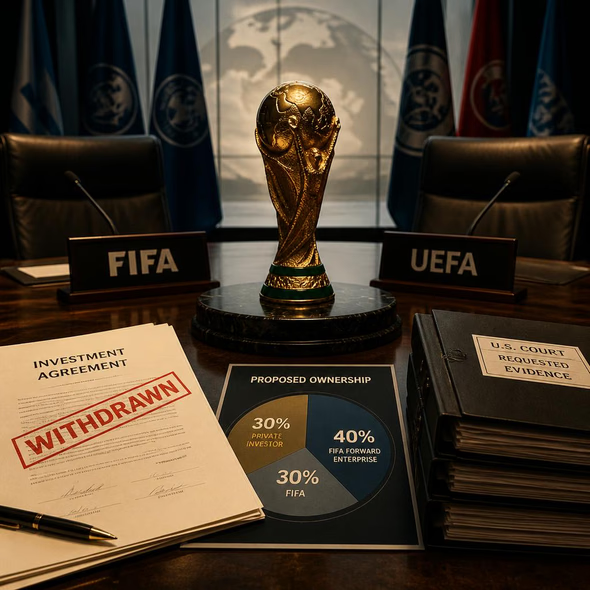
The strongest case for outside investment is that FIFA could gain capital and commercial skill while retaining sporting control. The unresolved risk is that a financing instrument would become a durable claim on the scarce access and global audience that give the World Cup its value.
UEFA has asked a US federal court for permission to obtain testimony and documents for a possible criminal complaint in Switzerland against FIFA president Gianni Infantino and potentially other officials and advisers. The dispute concerns an abandoned proposal to place commercial rights connected to the men’s and women’s World Cups and the Club World Cup in a subsidiary called FIFA Forward Enterprise, then sell stakes to outside investors. UEFA is also seeking material from Joshua Kushner’s investment firm.
The procedural boundaries are important. UEFA has made allegations and is seeking evidence; the reporting does not establish a criminal finding against Infantino. Its filing alleges that the proposal was developed in secret by a small group and bypassed FIFA’s usual governance, including consultation with its council, regional confederations, and member associations. What the documents show—and what Swiss authorities might do with them—remains unresolved.
The case for capital
Outside investment is not inherently absurd. A private investor could provide capital, commercial expertise, and incentives to develop media and sponsorship income across several tournaments. FIFA might argue that a subsidiary can isolate commercial operations while the federation keeps authority over sporting rules. If the valuation is strong and the limits are firm, selling a minority stake could look more disciplined than borrowing against uncertain future revenue.
But a World Cup stake is not an ordinary share in a factory. Its value rests on scarce matches, exclusive broadcasts, sponsorship inventory, ticketing, host arrangements, and the compulsory attention generated by national teams. The investor would not have created most of those assets. It would be buying a claim on the gate through which audiences and commercial partners must pass.
That makes the contract’s control provisions more important than the headline valuation. Could an investor influence which rights are bundled, how often tournaments expand, which markets receive favorable access, or how commercial targets shape scheduling? Would it gain vetoes, board seats, information rights, or protections against later policy changes? Minority ownership can carry majority leverage when an organization becomes dependent on promised capital or growth.
Follow the design
The requested evidence may show who conceived FIFA Forward Enterprise, how advisers valued its rights, which investors received access, and what approval route was anticipated. Draft contracts, presentation decks, messages, board materials, and fee arrangements could distinguish a speculative financing exercise from a plan advanced far enough to create duties or conflicts. They could also reveal whether abandonment ended the proposal or merely postponed its architecture.
National associations, players, host cities, broadcasters, sponsors, and supporters all help produce the World Cup’s legitimacy, though they do not share equal bargaining power. If FIFA can package that collective inheritance into an investable platform, the central question is not whether private money is impure. It is which terms let money govern access after the tournament has made itself indispensable. The documents may show whether FIFA designed a useful commercial vehicle or drafted a new landlord for football’s most valuable gate.
Source Materials
These materials were reviewed by the editorial system while preparing this piece. Muerte.casa may interpret, satirize, reframe, or disagree with them.
- UEFA asks US court for FIFA documents for criminal case against Infantino Al Jazeera · August 27, 2026 · Primary signal · Direct source
- Uefa pursuing criminal legal action against Infantino BBC · August 27, 2026 · Direct source
- Uefa prepares criminal complaint against Fifa’s Infantino Financial Times · August 27, 2026 · Direct source
How did this story land?
This may be changed as you like.