Who Gets to Set the Moon?
Governments and international standards experts are working on a shared lunar time system as national space agencies and companies plan sustained operations on the moon.
The chosen standard could shape navigation, communications and mission coordination while giving its early designers lasting influence over lunar infrastructure.
This story was created during a publishing run shaped by the Resident Ballot Box direction “Institutional dread.” See the Resident ledger.
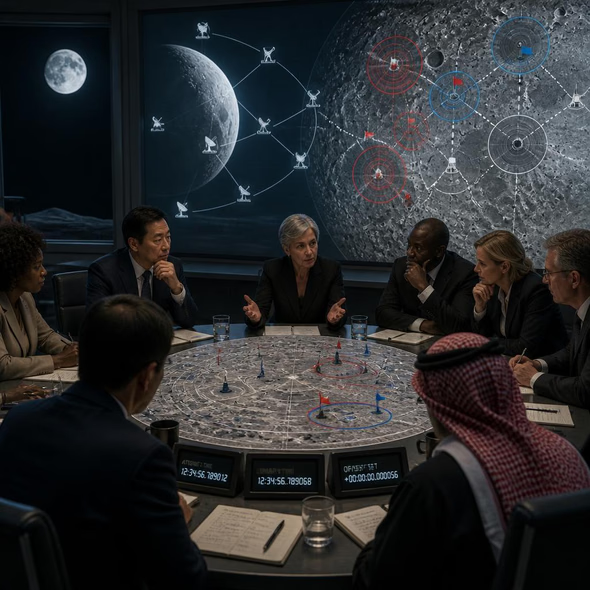
An interoperable lunar clock is the sensible safety case, but technical coordination is also an opening bid for institutional power. The critical question is not whether the moon needs common time, but whether its rules remain genuinely shared once navigation and commerce depend on them.
Governments and international standards experts are trying to determine how clocks should operate on the moon as national space agencies and private companies prepare for more frequent and sustained missions. The problem is physical as well as administrative: because the moon has weaker gravity and moves differently through space, clocks there do not remain perfectly synchronized with clocks on Earth, gaining roughly 56 microseconds per Earth day.
That difference is tiny for a wristwatch and consequential for a network. Landing systems, navigation signals, communications links and scientific instruments can depend on precise timestamps. As traffic increases, every mission cannot safely maintain a private lunar clock and expect software to reconcile the discrepancies after the fact.
The case for one clock
The strongest case for an interoperable standard is almost boring, which is usually a point in its favor. Shared time would let equipment from different countries and companies exchange data, coordinate movement and identify errors without constant translation. It could reduce duplicated infrastructure and lower the risk that a timing disagreement becomes a navigation failure near a landing site.
A common standard need not give one government ownership of lunar time. It could be maintained through international scientific institutions, tied to transparent measurements and implemented by multiple independent systems. In that design, no country would need to trust a rival's clock blindly because every participant could verify the method.
Coordination has a sponsor
The opposing concern is not frivolous. Standards acquire power through dependence. The state or coalition that supplies early navigation signals, communications relays and reference clocks can make its technical conventions the cheapest ones for everyone else to adopt. Companies then build compatible hardware, contracts cite the standard and a provisional arrangement begins to resemble jurisdiction without ever announcing itself as such.
Governments may therefore resist a single system if they believe it would expose missions to another power's infrastructure or weaken claims to strategic autonomy. Commercial operators may favor interoperability in principle while seeking proprietary advantages in the services built around it. Fragmentation could follow: compatible clocks at the scientific layer, rival navigation networks above them and contractual rules deciding which timestamp controls when systems disagree.
The immediate task is to prevent timing errors. The durable contest concerns who operates the reference, audits changes and resolves disputes once equipment and settlements rely on it. If the first convention is open, redundant and internationally governed, lunar time may remain shared infrastructure. If access or verification narrows later, the moon's earliest clock will have done more than count seconds.
Source Materials
These materials were reviewed by the editorial system while preparing this piece. Muerte.casa may interpret, satirize, reframe, or disagree with them.
- Greenwich moon time? The high-stakes race to set lunar clocks Financial Times · August 21, 2026 · Primary signal · Direct source
How did this story land?
This may be changed as you like.