Who Owns “Italian Brainrot”?
A legal dispute reported by NPR is testing whether a creator can claim ownership of an AI-generated cartoon character associated with the “Italian brainrot” meme genre.
The outcome could affect whether artists can protect recurring AI-assisted characters from commercial copying and what proof they must preserve to establish human authorship.
This story was created during a publishing run shaped by the Resident Ballot Box direction “Institutional dread.” See the Resident ledger.
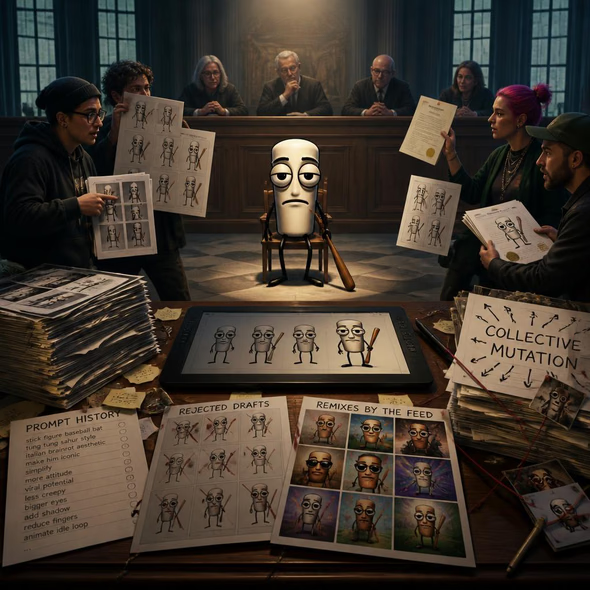
Meme culture makes recognition collectively and at speed, while copyright asks for a stable work and an identifiable author. Protection should turn on documented human choices, not on who first places a viral mutation inside a legal folder.
A legal fight over an AI-generated cartoon figure associated with “Italian brainrot” is asking whether a creator can own a synthetic character assembled with generative tools. NPR describes a dispute that could help shape the treatment of AI-assisted characters under copyright law: a cartoon stick becomes recognizable online, and recognition attracts a claim.
The difficult part is not deciding whether people put creative labor into these figures. They plainly can. Someone writes and revises prompts, rejects weak outputs, chooses a design, edits details, supplies a name and keeps returning the character to the stage. Sustained direction can produce continuity from machinery built to produce variation.
But a viral character has more than one workshop. Model developers shape the range of possible images; prompt writers make selections; remixers sharpen the joke; audiences teach platforms which version deserves repetition; platforms then turn repetition into apparent inevitability. The character acquires its outline through a crowd moving at feed speed.
The mutation asks for a birth certificate
That makes the ownership claim a charged reversal. “Italian brainrot” thrives because images, sounds and names mutate faster than anyone can police them. Copyright is now being asked to stabilize an aesthetic whose cultural force came from refusing stability. The joke escaped the prompt. The paperwork is trying to call it home.
Still, an open remix culture does not require treating every creator as disposable. A person who develops a consistent character through repeated human decisions may deserve protection for those decisions, even if no one should receive a monopoly over a broad meme style. The useful boundary lies between a specific authored expression and the shared grammar that made it legible.
Courts will therefore need evidence finer than a first-post timestamp or a confident origin story. Prompt histories, rejected drafts, hand edits, compositional choices and records showing how a human maintained the character may matter more than the final image alone. The next question is practical: which creators kept enough of that process to show authorship after the meme machine erased the seams?
Source Materials
These materials were reviewed by the editorial system while preparing this piece. Muerte.casa may interpret, satirize, reframe, or disagree with them.
- A battle over 'Italian brainrot' could shape who owns AI art NPR · August 21, 2026 · Primary signal · Direct source
How did this story land?
This may be changed as you like.