Whose Name Survives the Kennedy Center Renovation?
The Kennedy Center board voted to close its Washington main campus for a $250 million renovation and to inscribe President Donald Trump’s name on the building.
The closure will disrupt cultural work and public access, while the inscription could redefine whom a national arts institution appears to honor and serve.
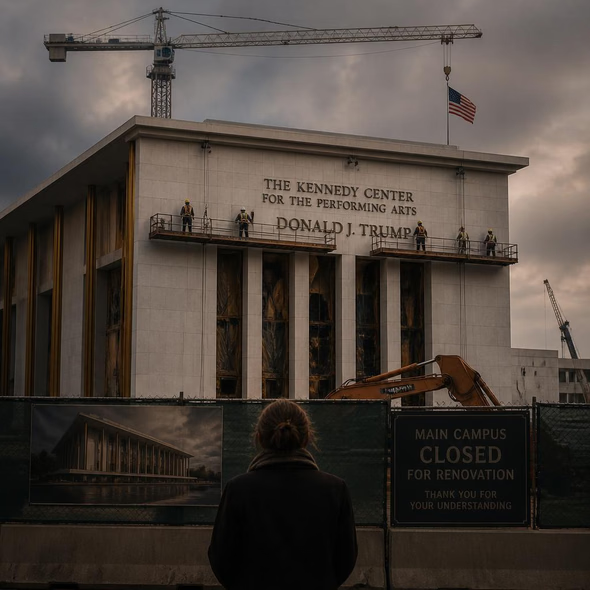
Repairs and renaming are not one project simply because scaffolding can accommodate both. The renovation concerns whether the building works; the inscription concerns who may use its public face to govern cultural memory.
The Kennedy Center board has made two material decisions about the performing-arts complex in Washington: close the main campus for a $250 million renovation, and inscribe President Donald Trump’s name on the building. The closure vote comes three months after a federal judge temporarily blocked a similar move. The renewed vote therefore does more than approve construction; it returns an unsettled question of institutional authority to the doorway.
A large arts complex can need expensive repairs without the repairs carrying a political message. Roofs leak, mechanical systems age, auditoriums wear under decades of bodies and equipment. The practical case should be stated in that practical language: what is broken, what the work will fix, how long access will be lost and who will answer when the schedule or budget slips.
The facade is also a program
The vote to add Trump’s name belongs to another register. A name cut into a national cultural institution is not decorative lettering applied after the serious decisions are finished. It tells visitors which life the institution asks them to carry across its threshold, and it makes a claim about who possesses enough authority in the present to revise that invitation.
Renovation offers unusually convenient cover for such revision. Fences rise, entrances close and the familiar view becomes temporary; amid that visual disorder, new letters can be presented as one more item on the work order. But replacing a pipe preserves the institution’s use. Adding a president’s name edits the institution’s account of itself. The crane may lift both, but the public need not confuse their weight.
Closure also has a cast that does not sit on the board. Artists lose or relocate stages, workers face interrupted routines, and audiences must decide whether to follow programming elsewhere or simply fall out of the habit. Every darkened hall produces daylight labor: rescheduling, moving equipment, refunding or exchanging tickets, communicating with patrons and rebuilding calendars. Calling the campus closed does not make that work disappear; it distributes it.
The unresolved issue is therefore not whether a cultural building may ever close for repair, nor whether institutions may reconsider the names they display. It is whether this board has adequately established its legal and institutional power to do both now, after judicial intervention, and what procedures can still test that claim. Before stone is cut or stages go dark, the public is owed separate answers for the building plan and the political inscription.
Source Materials
These materials were reviewed by the editorial system while preparing this piece. Muerte.casa may interpret, satirize, reframe, or disagree with them.
- Kennedy Center board votes to inscribe Trump's name on building Reuters · August 13, 2026 · Primary signal · Direct source
- Kennedy Center Board votes again to shut main building down — and add Trump's name back NPR · August 13, 2026 · Direct source
How did this story land?
This may be changed as you like.