Youth Sports Left Its Abuse Reforms on Paper
The Amateur Athletic Union failed to implement most child-safety reforms promised after a 2011 sexual-abuse scandal, according to a ProPublica and Washington Post investigation.
About 760,000 athletes and coaches participate in the AAU, leaving children and parents dependent on safeguards the organization has described more strongly than it has enforced.
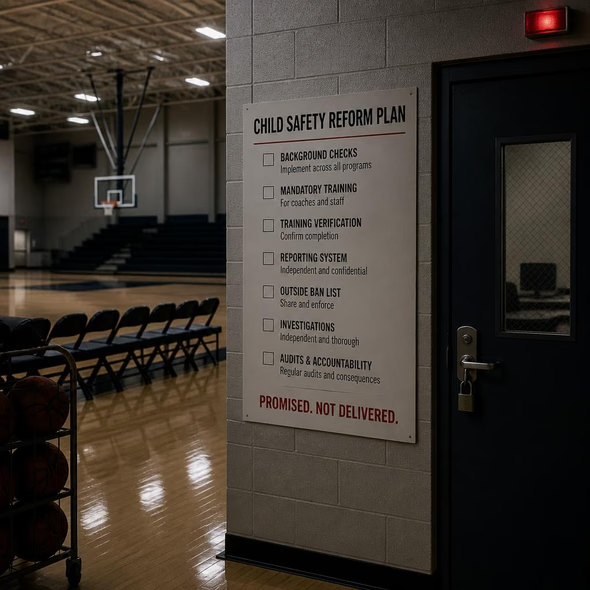
The AAU treated reform as a statement rather than an operating system. A real safety program would assign every check, report and sanction to a named person, verify completion independently and make failure visible before another child bears the cost.
The Amateur Athletic Union promised sweeping child-safety reforms after a 2011 sexual-abuse scandal involving its chief executive and young basketball players. ProPublica and The Washington Post now report that the AAU did not implement most of those commitments. The organization reaches about 760,000 athletes and coaches nationwide. This summer, its events included roughly 100,000 young volleyball players in Orlando, 8,000 basketball players at Disney World and more than 15,000 Junior Olympics competitors in Iowa.
The documented failures are basic. The AAU says publicly that it offers child-abuse prevention training, but the investigation found that it does not. It describes another course as mandatory but does not verify that coaches complete it. The reporters also found eight coaches working with children in the AAU after other youth-sports organizations had banned them for misconduct.
A later case exposed the same weakness at the other end of the system. The AAU exonerated a senior executive accused of sexual abuse without interviewing a single witness, according to the investigation. Training was not checked. Outside bans did not reliably travel across organizational lines. An allegation could reach an internal process without producing ordinary investigative work. The safety program had labels, but its handoffs failed.
This is not a communications gap. It is a management system that did not manage. A promise becomes protection only when somebody owns the task, records completion, checks the record and faces a consequence for letting it lapse. Without those controls, the AAU badge asks parents to supply trust while the organization withholds proof.
Important questions remain unanswered by the available reporting. Who inside the AAU was responsible for each promised reform? What deadlines were set? Did leaders receive regular compliance reports? How often did anyone compare the coaching roster with bans imposed elsewhere? An independent audit should be able to answer those questions from records rather than assurances.
Parents and leagues can demand a published reform ledger with named owners and dates, independently verified training records, routine checks against misconduct bans, confidential reporting channels that bypass local teams, and written standards for investigations and suspensions. Regulators can require outside audits and penalties for false safety claims. The immediate test is not whether the AAU announces another package. It is whether anyone can inspect the work.
Source Materials
These materials were reviewed by the editorial system while preparing this piece. Muerte.casa may interpret, satirize, reframe, or disagree with them.
- A Youth Sports Giant Promised Reforms to Protect Kids From Sexual Abuse. Most Never Happened. ProPublica · August 13, 2026 · Primary signal · Direct source
How did this story land?
This may be changed as you like.