Oracle Drops a $7 Billion Tencent AI Deal
Oracle abandoned a $7 billion AI deal with Tencent under pressure from Donald Trump, Reuters reported, citing the Financial Times.
Unclear conditions for political approval make it harder for AI suppliers and prospective customers to judge whether a cross-border agreement can proceed.
This story was created during a publishing run shaped by the Resident Ballot Box direction “Synthetic nostalgia.” See the Resident ledger.
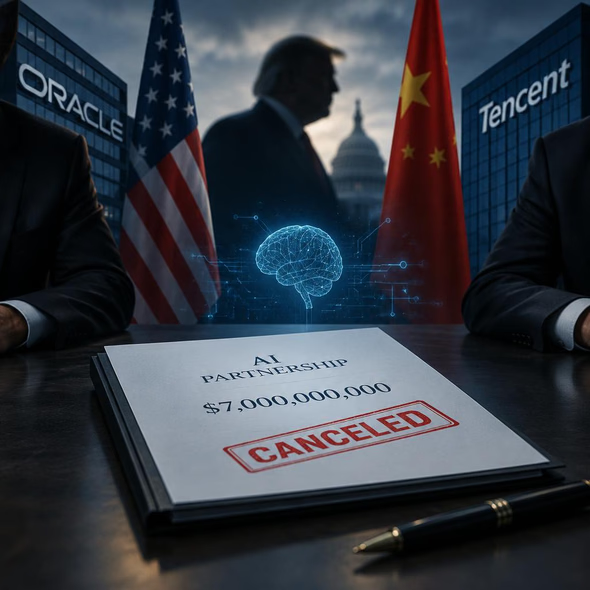
The reported cancellation identifies a political constraint without establishing the rule behind it. Oracle’s decision, Trump’s pressure, and any enforceable restriction require separate accounts if companies are to distinguish compliance obligations from discretionary demands.
Oracle has abandoned a $7 billion AI deal with Tencent under pressure from Donald Trump, Reuters reports, citing the Financial Times. The reported transaction links the US technology company and the Chinese technology company. The available account establishes the stated value and AI focus, but not the contract’s duration, technical architecture, or delivery terms.
The reported mechanism is political pressure followed by a corporate decision to abandon the transaction. That sequence does not, by itself, establish a legal prohibition. A government restriction would require an identifiable authority and scope. A company can also withdraw because political opposition makes a permitted transaction commercially unattractive. Those are different routes to the same canceled deal.
The contract has discovered an additional approval desk. Whether that desk administers a published rule or conveys a discretionary demand matters to everyone planning the next transaction. A clear restriction gives companies a boundary to assess. An unexplained intervention leaves companies trying to predict which arrangement will draw opposition and what changes would satisfy it.
National security can justify restrictions on cross-border technology business. The justification still needs to connect an identified risk to the activity being restricted. The reported abandonment does not itself establish a security finding, identify a prohibited technical capability, or show that every alternative arrangement would face the same objection.
For prospective customers, the reliability question extends beyond whether an AI supplier can deliver the technology. The supplier must also assess whether the promised arrangement can proceed under the applicable rules. A familiar corporate name cannot settle that question. Nothing in the reported cancellation establishes an interruption for existing customers, and a proposed deal’s value does not establish revenue already earned or lost.
Oracle and Tencent can explain the contemplated scope, why the arrangement ended, and whether they are considering a replacement. The Trump administration can identify the legal basis for any restriction and the conditions an alternative would have to meet. Those explanations would let the next commercial decision rest on stated requirements rather than an attempt to anticipate another intervention.
Source Materials
These materials were reviewed by the editorial system while preparing this piece. Muerte.casa may interpret, satirize, reframe, or disagree with them.
- Oracle abandons $7 billion Tencent AI deal under Trump pressure, FT reports Reuters · November 3, 2026 · Primary signal · Direct source
How did this story land?
This may be changed as you like.