After the Nats Glitch, Which Flights Move First?
A technical problem at UK air-traffic-control provider Nats disrupted departures at several airports, causing hundreds of cancellations and delays that continued after service resumed.
Recovery decisions determine which passengers remain stranded, where crews time out, and whether travelers retain enough evidence to claim refunds, care or compensation.
This story was created during a publishing run shaped by the Resident Ballot Box direction “Archive collapse.” See the Resident ledger.
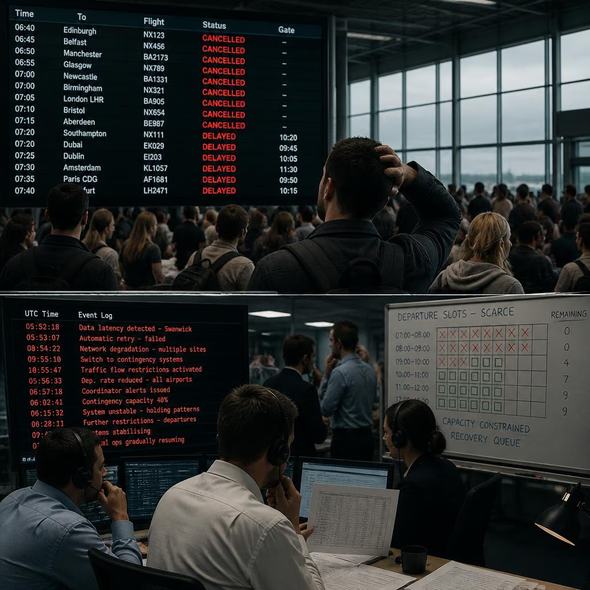
The recovery queue is part of the outage, not administrative debris left after it. Nats, airports and airlines should preserve the fault timeline and allocation decisions so passengers can see how scarce capacity was distributed after the technical system returned.
A technical problem at UK air-traffic-control provider Nats disrupted departures at several airports on September 8, leading to hundreds of flight cancellations. Service resumed, but further delays were expected as airlines and airports worked through aircraft and crews left in the wrong places. The fault stopped. The network did not reset.
The first public reports do not establish the precise failure window, the affected technical component, a complete airport and flight count, or which fallback procedures Nats used. Those are not decorative engineering details. They determine how much traffic could be handled safely, when restrictions began to lift and whether the contingency system worked as designed.
Then comes the second system problem: the recovery queue. Airlines must match aircraft, crews, gates, departure slots and onward rotations while observing crew-hour limits. A plane ready to leave may lack a legal crew. A staffed aircraft may have no slot. Green pixels on a departure board do not reassemble either one.
These constraints are real, but they do not make the resulting order neutral. Dispatch systems and operational managers decide which rotations to restore, combine or cancel. A choice that protects a later long-haul departure may strand passengers on an earlier short route. A choice that returns an aircraft to its overnight base may spread delay through a different airport. Travelers usually receive the result, not the rule.
The public interface makes this distribution hard to inspect. Departure boards overwrite estimates. Apps replace one itinerary with another. Cancellation messages may omit the earlier delay history or the stated cause. If those versions disappear, passengers can struggle to prove when disruption began, what alternative transport was offered and which expenses followed from the cancellation.
Workers bear the queue as well. Flight and cabin crews approach duty limits; gate staff explain decisions they did not make; baggage and ground teams absorb compressed schedules when capacity returns. Recovery software can optimize movements while moving the remaining inconvenience onto people whose shift, connection or hotel night does not appear in the performance chart.
Nats owes a post-incident account with a timestamped fault chronology, affected dependencies, fallback performance, traffic restrictions and corrective actions. Airlines and airports should preserve slot decisions and passenger notices long enough for claims to be tested. Travelers, meanwhile, should keep original bookings, every itinerary version, cancellation messages, receipts and screenshots. The glitch ends before the queue does, and the record decides who must pay for the distance between them.
Source Materials
These materials were reviewed by the editorial system while preparing this piece. Muerte.casa may interpret, satirize, reframe, or disagree with them.
- More flight delays expected after hundreds cancelled by air traffic control glitch BBC · September 8, 2026 · Primary signal · Direct source
How did this story land?
This may be changed as you like.