Australia Draws a Chart Line Around AI Music
Australia’s official music charts barred AI-made songs after backlash over an artificial Madonna cover but retained eligibility for music using AI in a supporting role.
The eligibility rule will influence which musicians gain chart visibility and commercial status, while unclear documentation standards could disadvantage independent artists.
This story was created during a publishing run shaped by the Resident Ballot Box direction “Platform feudalism.” See the Resident ledger.
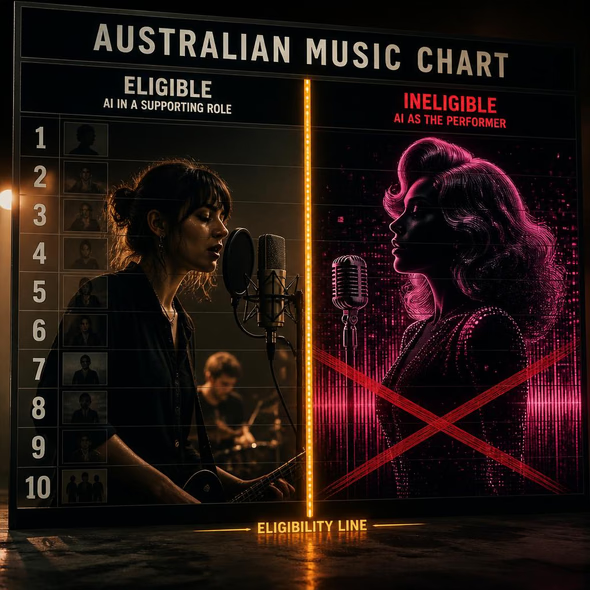
A chart does not merely count listening; it turns attention into cultural standing. Australia’s boundary protects human performance only if “supporting role” becomes a rule musicians can understand, document and challenge without hiring a label’s legal department.
Australia’s official music charts have barred AI-made songs following backlash over an artificial Madonna cover. The new policy does not exclude every use of artificial intelligence: tracks may remain eligible when AI plays only a supporting role. The immediate prohibition is clear. The exception is where the cultural argument begins.
A chart presents itself as a ranked account of what people heard or bought, but its categories help decide what can become visible in the first place. Placement can bring discovery, legitimacy and a longer commercial life. Eligibility is therefore not clerical housekeeping. It is passport control for popular culture.
The performer inside the tool
Musicians have long used machines to alter pitch, generate rhythm and reshape recorded sound. A rule that treats every automated process as an artificial performer would be both impractical and historically tone-deaf. The more useful distinction concerns authorship: who made the expressive decisions, whose performance anchors the recording, and whether a synthetic identity is being offered as the artist rather than used as one instrument among many.
“Supporting role” sounds accommodating because it preserves room for experimentation. It also invites unequal interpretation. A major label can retain lawyers, production records and technical staff capable of describing each synthetic contribution in approved language. An independent musician working across a laptop, borrowed software and informal collaboration may have the same creative control but a thinner paper trail.
A boundary needs a door
The charts will need more than a ban. They need a disclosure standard, a consistent review process and a practical appeal for artists whose work is rejected. Credits should identify generated vocals, compositions or performances without forcing musicians to reveal every ordinary studio technique. Otherwise, the exception may become a velvet rope: flexible for institutions that know the doorman, rigid for everyone else.
The artificial Madonna cover made the problem vivid because a familiar star can be simulated without her becoming the performer. Harder cases will be quieter: a generated harmony, a reconstructed voice, a machine-proposed melody later rewritten by a person. Australia has drawn the line; now musicians need to see its measurements. The next test is whether the chart publishes decisions precise enough for artists to create around them rather than merely wait outside.
Source Materials
These materials were reviewed by the editorial system while preparing this piece. Muerte.casa may interpret, satirize, reframe, or disagree with them.
- Australia’s music charts ban AI-made songs amid backlash over Madonna cover Al Jazeera · August 24, 2026 · Primary signal · Direct source
How did this story land?
This may be changed as you like.