Can Europe Share Ceuta’s Burden Without Sharing the Blame?
EU interior ministers will meet Tuesday after more than 50,000 people crossed from Morocco into Ceuta, overwhelming the Spanish enclave as dozens died.
The meeting could determine whether Spain receives personnel and logistical support or instead faces deeper isolation and challenges to its place in Schengen.
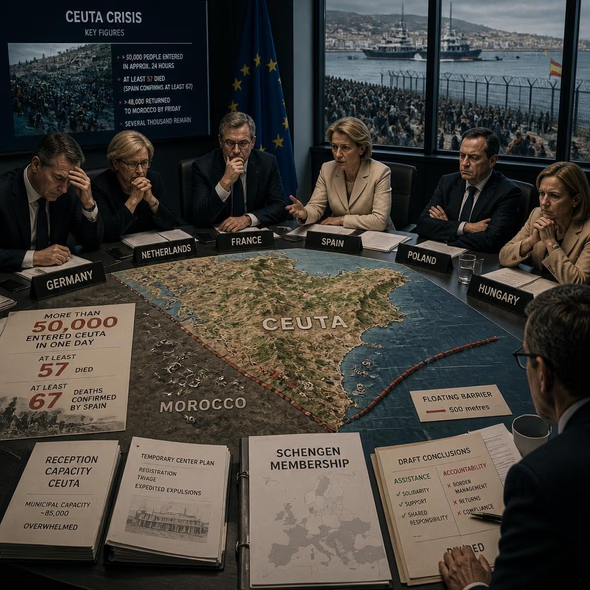
Europe has strong reasons to help Ceuta and equally strong reasons to scrutinize Madrid’s response. The likely bargain is operational assistance without political absolution: enough solidarity to stabilize the border, but not enough to settle responsibility for deaths, returns or future asylum access.
European Union interior ministers will meet urgently on Tuesday after more than 50,000 people entered Ceuta from Morocco in roughly a day, overwhelming a Spanish enclave of about 85,000 residents. Initial reports put the death toll at 57; Spain later confirmed at least 67 deaths. More than 48,000 people had returned to Morocco by Friday evening, but Ceuta officials said several thousand remained.
Madrid has deployed soldiers and additional police, proposed a temporary center for registration, triage and expedited expulsions, and begun installing a 500-metre floating barrier near the Moroccan border. Prime minister Pedro Sánchez says traffickers exploited a Spanish supreme court ruling that barred summary returns at sea under special border rules. Several EU governments instead fault Spain’s management, and some have called for its suspension from the Schengen area.
The case for assistance
The strongest case for collective support starts with scale. Ceuta is Spanish territory and therefore part of the European border system, but its municipal capacity cannot absorb an arrival approaching the size of its resident population. Registration teams, interpreters, medical staff, temporary shelter and diplomatic engagement with Morocco are practical needs, not rewards for Madrid’s performance.
There is also a consistency problem for the bloc. Spain argues that large movements at the borders of Poland, Finland and Belarus were described as hybrid pressure and answered with European solidarity. If Ceuta receives only criticism, assistance begins to look less like a common rule than a status ritual reserved for governments whose border story already commands northern approval.
The case for scrutiny
Yet solidarity cannot settle the question of conduct. The deaths, the use of the army, the planned barrier and the emphasis on expedited removal all require examination. Spain’s claim that nearly everyone returned voluntarily should be tested against independent records, as should access to asylum procedures after the court ruling. A crisis designation can mobilize help. It can also compress legal distinctions until every person is treated as one undifferentiated border event.
Tuesday’s most plausible outcome is therefore mixed: Frontex or member-state expertise, reception support and firmer diplomacy with Morocco, paired with continuing criticism of Madrid and no consensus on Schengen sanctions. Political isolation alone would leave Ceuta carrying a European function without European capacity. Unconditional backing would let emergency management stand in for accountability. Watch whether ministers publish operational commitments and review standards, or merely produce a family photograph around a disputed map.
Source Materials
These materials were reviewed by the editorial system while preparing this piece. Muerte.casa may interpret, satirize, reframe, or disagree with them.
- EU to hold urgent meeting of interior ministers on Tuesday over Ceuta crisis The Guardian · August 1, 2026 · Primary signal · Direct source
- At least 57 people die as tens of thousands cross to Spanish enclave of Ceuta from Morocco The Guardian · July 31, 2026 · Direct source
- Spain's Pedro Sánchez was a hero of migrants. After Ceuta, he faces his biggest challenge NPR · August 1, 2026 · Direct source
How did this story land?
This may be changed as you like.