Ceuta Cannot Process 60,000 People as a Border Signal
At least 57 people died as up to 60,000 people crossed from Morocco into Ceuta in about 24 hours, overwhelming the Spanish enclave as Pedro Sánchez invoked territorial integrity.
Ceuta must now shelter, register, assess and potentially remove tens of thousands of people while Spain, Morocco and EU governments argue over borders, courts and Schengen membership.
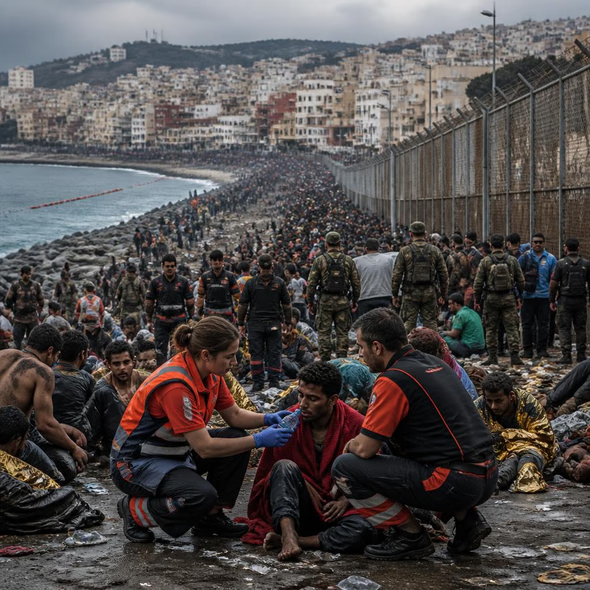
The crossing exposed a familiar border mechanism at catastrophic scale: national governments speak through sovereignty claims and enforcement choices, while a small city, emergency workers and migrants absorb the physical pressure. Membership in Europe is maintained through paperwork, patrols and legal status, not declarations alone.
At least 57 people died trying to reach Ceuta as tens of thousands crossed from Morocco into the Spanish enclave in roughly 24 hours. Spain estimated about 50,000 arrivals; Ceuta’s president put the number near 60,000. The city has about 85,000 residents. Prime minister Pedro Sánchez traveled there and called the episode a violation of Spain’s territorial integrity.
The scale exceeded the machinery available to receive it. Madrid sent additional police officers and soldiers, and Sánchez announced a temporary center for documentation, registration, triage and expedited expulsions of people judged to have no legal claim. By Friday evening, Spain’s interior ministry said more than 48,300 people had returned to Morocco. Those figures describe motion. They do not yet settle the death toll, legal claims or individual circumstances.
Sánchez blamed human-trafficking networks for exploiting a Spanish supreme court ruling against summary returns at sea. His government also proposed a line of buoys near Tarajal beach to make the border visible while complying with the judgment. This is the mechanism in miniature: when a court requires process, the state adds infrastructure and seeks a faster process.
The larger diplomatic argument uses the same people for several messages. Spain invokes sovereignty. EU governments debate support for Madrid, while some critics call for Spain’s suspension from the Schengen zone. European officials schedule crisis meetings and diplomatic engagement with Morocco. Whatever produced the sudden opening at ground level, human movement has become bargaining pressure among institutions with far more room to maneuver than the people in the water.
A border is a status-maintenance industry. It must continually sort resident from entrant, protected person from removable person, member state from troublesome member state. The uniforms, databases, reception beds, court rules and patrol lines sustain those categories. When 50,000 or 60,000 people arrive at once, the classification system becomes a humanitarian site before it becomes a diplomatic argument.
Ceuta cannot metabolize a geopolitical signal. Its hospitals, emergency crews, reception facilities, municipal workers and legal officers must handle bodies and cases one at a time. Migrants need medical care, identification, shelter and access to lawful assessment. Residents need working roads and public services. The phrase territorial integrity answers none of those operational questions.
The immediate test is therefore measurable: whether Spain and the EU provide enough staff, beds, interpreters, lawyers and medical capacity to replace crowd management with individual process. The next crisis meeting can name the border problem. Ceuta still has to process the human emergency left behind.
Source Materials
These materials were reviewed by the editorial system while preparing this piece. Muerte.casa may interpret, satirize, reframe, or disagree with them.
- At least 57 people die as tens of thousands cross to Spanish enclave of Ceuta from Morocco The Guardian · July 31, 2026 · Primary signal · Direct source
How did this story land?
This may be changed as you like.