Data Centers Are Writing the Gas Buildout
Donald Trump urged US communities to accept data centers as Global Energy Monitor counted more than 189 gigawatts of gas projects tied to their power demand by mid-2026.
Gas plants, pipelines and grid upgrades can impose decades of costs and emissions even if the data-center contracts used to justify them shrink or disappear.
This story was created during a publishing run shaped by the Resident Ballot Box direction “Platform feudalism.” See the Resident ledger.
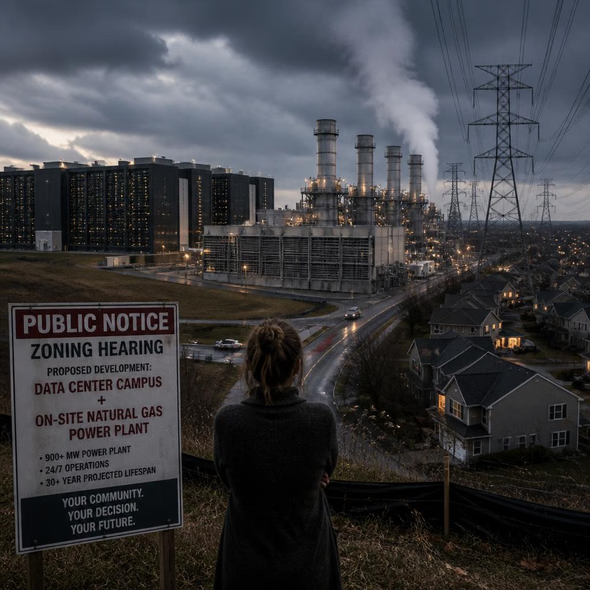
The sales pitch treats the campus as the customer and the power supply as background. The order should be reversed: residents need to know which company guarantees demand, who pays if it falls short, and which permits and pollution remain after the servers move on.
President Donald Trump told Americans that communities rejecting data centers were making a mistake during an interview with his former attorney Michael Cohen. At the same time, Global Energy Monitor reported that the US pipeline of gas-power projects tied exclusively to data centers had passed 189 gigawatts by mid-2026, up from 97 gigawatts at the end of 2025 and 4 gigawatts in early 2024. These are projects announced, in development or under construction, not 189 gigawatts already operating. The direction is still hard to miss.
The mechanism is simple. Data-center operators want large quantities of electricity without waiting years for ordinary grid connections. Developers increasingly propose private, behind-the-meter gas plants beside server campuses. The arrangement can keep some costs away from utility customers, especially when the technology company supplies its own power. It can also move a consequential energy decision into negotiations organized around one customer’s schedule.
Trump’s pitch emphasizes jobs and tax revenue. A community can reasonably want both. But those benefits must be separated from the infrastructure bargain. Construction employment is not the same as permanent employment. Projected tax receipts are not the same as collected revenue. Neither answers who pays for transmission, fuel connections, backup capacity or utility upgrades beyond the fence.
The gas plant is the long contract hiding inside the development announcement. Its permits, turbines and emissions can endure after a computing strategy changes, a corporate tenant leaves or electricity demand proves lower than forecast. If a utility builds on anticipated growth, ratepayers may inherit part of the mismatch. If the plant is private, neighbors still receive its local pollution and the region still records its greenhouse gases.
There is a cleaner version of the bargain, but it requires enforceable terms rather than a voluntary promise to bring power. The data-center owner can guarantee construction costs, cover decommissioning, disclose expected water and electricity use, and accept responsibility for stranded equipment. Regulators can test whether forecasts depend on permanent growth from an industry whose products and preferred hardware change quickly.
The scale matters because each approval can look local while the combined buildout changes national energy policy. Global Energy Monitor’s pipeline suggests that AI demand is not merely consuming available electricity; it is influencing what the country plans to generate next. The cloud has acquired a combustion chamber.
Communities do not need to reject every data center to reject a blank check. Before approving one, local officials can publish the power contract, identify the party carrying demand risk and state whether households will pay more if the forecast fails. The unresolved question is not whether a campus looks modern. It is who remains liable when its promised future changes.
Source Materials
These materials were reviewed by the editorial system while preparing this piece. Muerte.casa may interpret, satirize, reframe, or disagree with them.
- Trump Says You’re a Rube If You Don’t Want a Data Center in Your Backyard Futurism · August 24, 2026 · Primary signal · Direct source
- Data Centers Are Driving an Alarming Gas Power Expansion in the US Wired · August 24, 2026 · Direct source
How did this story land?
This may be changed as you like.