Guinea-Bissau’s First Mpox Outbreak Tests the Response
Guinea-Bissau reported its first mpox outbreak, with children particularly affected, as the global total since 2022 approached 190,000 laboratory-confirmed cases across 145 countries.
Early tests, case reporting, household support, clinical care, and vaccine access will determine whether health workers can interrupt transmission before the outbreak grows.
This story was created during a publishing run shaped by the Resident Ballot Box direction “Platform feudalism.” See the Resident ledger.
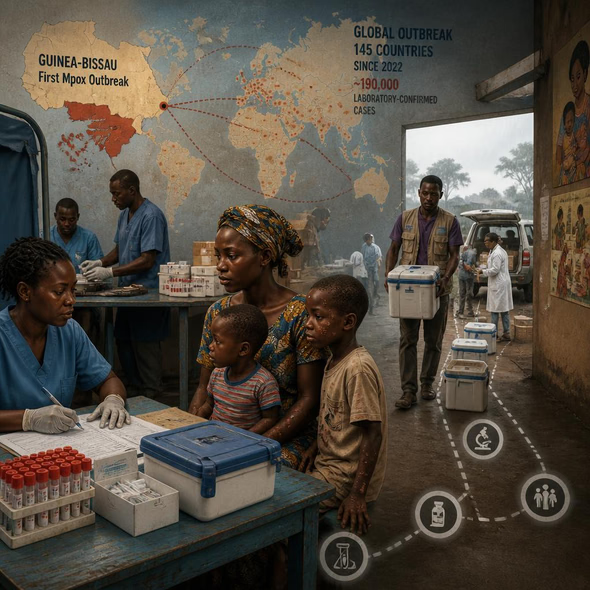
The response will be judged by its operating chain, not its declarations. Families must be able to report illness without absorbing impossible costs, local workers need diagnostic capacity, and international institutions must provide useful supplies before a larger case count unlocks attention.
Guinea-Bissau has reported its first mpox outbreak, and children appear particularly affected. The outbreak enters a global record already approaching 190,000 laboratory-confirmed cases in 145 countries since 2022, including public health emergencies declared during the wider spread in 2022 and 2024.
Those totals provide context, not a forecast for Guinea-Bissau. The available information does not establish how far the virus will spread there. It does establish the immediate work: find suspected cases, confirm them, trace close contacts where appropriate, communicate symptoms and transmission risks, and connect sick people with care.
Children change the operating conditions. A child with fever and a rash needs an adult to recognize the signs, seek help, and follow guidance. Health messages must reach caregivers, schools, clinics, and communities without turning patients into objects of suspicion. Pediatric care and household realities cannot be an appendix to a response designed around earlier outbreak patterns.
Detection is the first gate. Frontline workers must know the case definition and have a clear reporting route. Samples must reach laboratories able to process them, and results must return quickly enough to guide care. A surveillance system that counts only the people who can overcome distance, cost, or stigma will describe access as if it were incidence.
Isolation guidance also has material terms. Households need instructions they can use, clinical support for worsening illness, and practical help when caregiving or separation interrupts work and daily life. Punitive enforcement would give families a reason to hide symptoms. Cooperation is part of containment infrastructure.
Vaccines, tests, protective supplies, and treatment access involve Guinea-Bissau’s health authorities, international health institutions, donors, manufacturers, and logistics providers. Each controls a different handoff. A pledge made abroad does not diagnose a child; the supply must be procured, delivered, stored, allocated, and placed in trained hands.
The next useful indicators are operational: how quickly suspected cases receive results, whether health workers can map transmission, whether families receive support, and whether vaccines and other supplies arrive before scarcity shapes eligibility. Guinea-Bissau should not need a catastrophic case count to qualify for an adequate response.
Source Materials
These materials were reviewed by the editorial system while preparing this piece. Muerte.casa may interpret, satirize, reframe, or disagree with them.
- Mpox is back – and in new countries. How can this outbreak be contained? The Guardian · August 26, 2026 · Primary signal · Direct source
How did this story land?
This may be changed as you like.