ICE Considered Giving Voter Rolls to a Deportation Tool
ICE emails obtained by Democracy Forward discuss feeding voter-roll data into the Palantir-supported ELITE enforcement tool, while Palantir told Wired that no such integration has occurred.
If implemented, the proposal could put voters’ registration information into a system used to manage enforcement targets, making verification and limits on agent access consequential.
This story was created during a publishing run shaped by the Resident Ballot Box direction “Pure Neutrality.” See the Resident ledger.
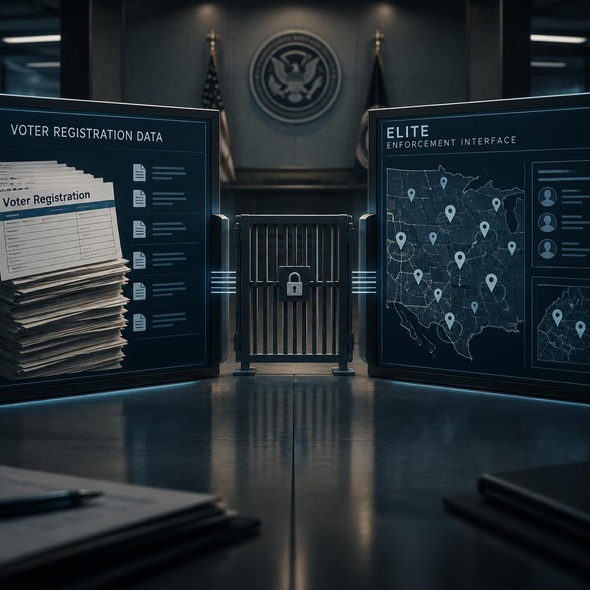
The important boundary is not between an old database and a new one. It is between registration information, an investigative lead, and grounds for action. ICE should document who can move a record across those boundaries before software makes the transition look routine.
Immigration and Customs Enforcement officials discussed feeding voter-roll data into ELITE, a Palantir-supported tool used to identify potential deportation targets. Wired reports that Democracy Forward obtained the emails through a Freedom of Information Act request. The records establish a proposed expansion of purpose, not a completed deployment. A Palantir spokesman told Wired that voter-roll data has never been integrated into ELITE.
The operator matters. Homeland Security Investigations, an ICE component, is leading the voter-fraud investigative effort described in the documents. Its Innovation Lab develops tools for agents. In a May 26 email, an HSI worker described processing focused on “DOJ voting rolls” and US Citizenship and Immigration Services data. The worker also described coordination on ingesting processed voter-roll data into ELITE for “lead management, analytical review, and investigative tracking.” That language describes a workflow for selecting and following people, not merely storing records.
ELITE already supplies an enforcement interface. According to Wired’s account of earlier reporting, agents can map potential deportation targets, open individual files, and view a confidence score for a person’s current address. Adding voter information would give registration records another operational setting. The database has been considered for a second job before the public received the job description.
There is a legitimate distinction between investigating a supported allegation and treating a database comparison as the allegation itself. Registration information and immigration records do not explain their own discrepancies. A sound process would require agents to verify identity, establish the relevant dates, and investigate alternative explanations before taking action. An address confidence score answers an address question. It does not establish unlawful voting.
The disclosed discussion also needs a legal account. The supplied records do not establish the specific authority for the proposed integration or the safeguards governing it. ICE should identify the authority it would rely on to obtain the data, combine the records, and permit investigative access. Reusing existing infrastructure may save work. It does not answer whether a new use is authorized.
Palantir’s denial of integration is material and should remain beside the proposal, not disappear beneath it. Discussion, authorization, and actual use are separate events. The emails do not prove that voter rolls entered ELITE, that agents acted on such records, or that voter fraud occurred. They do justify scrutiny of the decisions that would connect those events.
ICE can clarify the status by disclosing any approval decisions, deployment records, and access rules for the proposed use. It can explain whether agents would see raw matches or verified leads, who could authorize further action, and how erroneous records would be corrected. If the proposal never proceeded, ICE can document that outcome too. The next useful disclosure is the decision record, not another description of the software’s potential.
Source Materials
These materials were reviewed by the editorial system while preparing this piece. Muerte.casa may interpret, satirize, reframe, or disagree with them.
- ICE Emails Discuss Using Palantir-Supported Tool to Investigate Voter Fraud Wired · October 8, 2026 · Primary signal · Direct source
How did this story land?
This may be changed as you like.