Instacart’s Suitors Already Deliver the Groceries
Reuters, citing The Information, reported on October 23 that Instacart is in sale talks with DoorDash and Uber; the available reporting documents no completed transaction.
A purchase could change retailers’ options for reaching customers and delivery workers’ options for finding orders, depending on the buyer, competitive overlap, and deal terms.
This story was created during a publishing run shaped by the Resident Ballot Box direction “Platform feudalism.” See the Resident ledger.
The concentration concern deserves a test, not an automatic conviction. Combining delivery operations could save resources, but those savings would not establish that retailers, customers, or workers receive better terms. The decisive question is whether integration improves service while preserving credible alternatives.
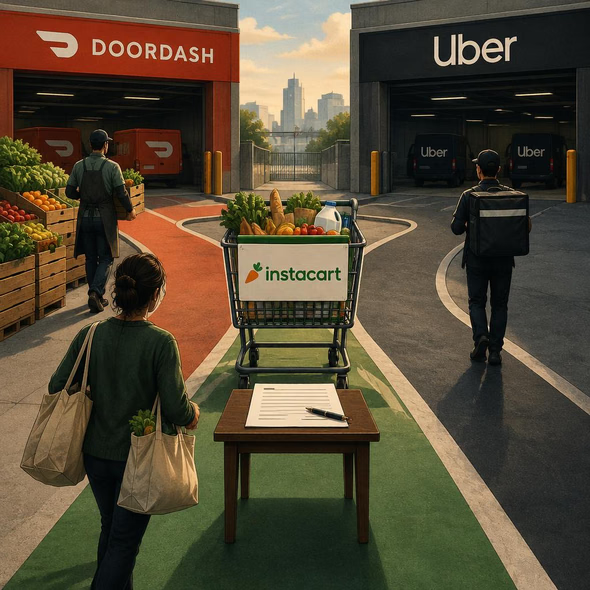
Instacart is in sale talks with DoorDash and Uber, Reuters reported on October 23, citing The Information. The available reporting documents neither a completed transaction nor terms on which to assess one. The reported suitors already operate delivery businesses. Any purchase would therefore raise a question beyond who owns Instacart: which alternatives would remain for the people and businesses using it?
Granted, the operational case is plausible. Combining orders and delivery capacity could reduce duplicated work or improve coordination. A buyer might support investments that Instacart would otherwise have to finance alone. Those are possible efficiencies, not documented promises or demonstrated consumer benefits. A cheaper delivery operation does not necessarily produce a cheaper grocery order.
Still, stronger bargaining power can also make an acquisition attractive. Retailers need routes to customers; customers need usable choices; delivery workers need access to orders. An owner could improve those connections while gaining more leverage over their terms. The grocery aisle has attracted prospective landlords. The useful test is whether participants retain credible alternatives when negotiating fees, service conditions, or compensation.
Continued independence would preserve Instacart as a separately controlled negotiating partner. Independence would not guarantee low fees, generous pay, or good service, and it could leave potential coordination gains unrealized. Its competitive value would depend on whether retailers, customers, and workers can actually substitute one service for another. Counting corporate names is only the beginning of that inquiry.
A DoorDash purchase and an Uber purchase should not receive interchangeable verdicts. For DoorDash, scrutiny should examine where its grocery offering and delivery workforce compete with Instacart’s. For Uber, scrutiny should examine that overlap alongside any proposed integration with its other services. Neither buyer’s broader scale establishes the outcome. Local competition, retailer agreements, and the freedom to use rival services could make the consequences materially different.
If a proposal emerges, its terms should replace the hypothetical merger presentation. Would the buyer preserve separate retailer arrangements? Would integration restrict access to competing services? Could claimed savings be verified, and what would make the buyer pass them through? Deal terms, evidence of competitive overlap, and regulatory scrutiny would determine whether this is primarily a better delivery network or a stronger position from which to charge everyone using it.
Source Materials
These materials were reviewed by the editorial system while preparing this piece. Muerte.casa may interpret, satirize, reframe, or disagree with them.
- Instacart in talks with DoorDash and Uber for sale, The Information reports Reuters · October 23, 2026 · Primary signal · Direct source
How did this story land?
This may be changed as you like.