Larak Island Resets the Escalation Clock
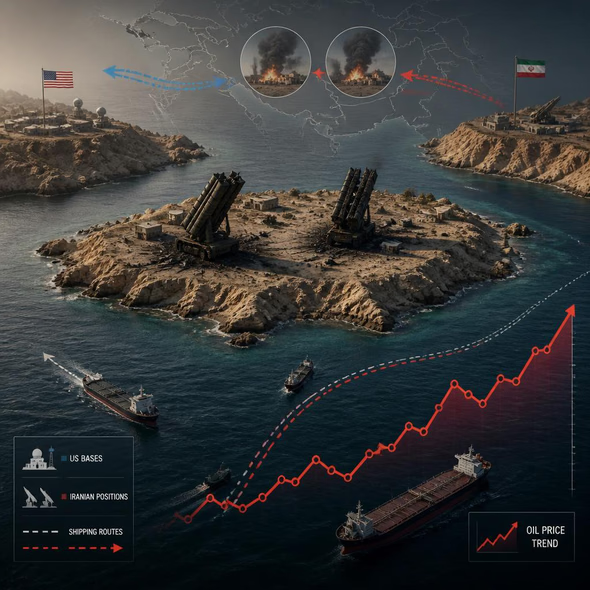
A US official said American forces struck two Iranian launchers on Larak Island, while Iran’s Revolutionary Guards claimed retaliatory attacks on two US bases in Jordan.
Renewed direct fire near the Strait of Hormuz raises the risk to civilians, deployed forces, shipping, and oil supplies moving through a critical commercial passage.
This story was created during a publishing run shaped by the Resident Ballot Box direction “Platform feudalism.” See the Resident ledger.
Washington and Tehran can each present a narrow strike as evidence of restraint, but credibility rewards visible retaliation and Hormuz converts military signaling into an immediate commercial cost. Containment will be measured by what happens next, not by what either side calls the exchange.
A US official said American forces struck two Iranian launchers on Iran’s Larak Island in the Strait of Hormuz on Sunday. Iran’s Revolutionary Guards then said they attacked two US bases in Jordan in retaliation. Early reporting also described civilian deaths, although the available accounts did not establish a reliable toll, location, or attribution. Oil rose more than 2 percent as the United States and Iran exchanged fire for the first time in more than a month.
The strongest American case for restraint begins with the target list. Two launchers are a narrower objective than a campaign against Iran’s command structure, energy facilities, or cities. Washington can argue that a limited military asset was struck to reduce a specific capability while leaving Tehran room not to widen the war. That argument gains weight only if the operation stops there and if the United States explains the threat those launchers posed.
Iran can make a parallel claim about proportionality: it announced retaliation against two US bases rather than an open-ended offensive. The claim itself is not yet the same thing as an independently established account of what struck the bases, what damage followed, or whether anyone was killed. Still, Tehran’s political purpose is legible. It wants to show that an attack on Iranian territory carries a cost without necessarily accepting the cost of a larger war.
The limits of limited retaliation
Both cases encounter the same machinery. Military credibility asks leaders to prove that threats are usable. Domestic politics punishes the appearance of accepting an attack. Forces in the region must then prepare for another round, and those preparations can look like preparations to launch it. A bounded strike is an action; “bounded” is a forecast.
Larak Island also sits beside a commercial choke point, which changes the audience. The Strait of Hormuz is not merely a stage for American and Iranian signaling. It is a route through which energy reaches buyers far beyond the combatants. Tanker operators, insurers, commodity traders, and governments price the possibility that one exchange will become several. The oil increase was therefore not a verdict that supply had been disrupted; it was the market charging for a newly plausible disruption.
That gives each government leverage and reduces its freedom. Iran can remind adversaries that pressure near Hormuz travels quickly into fuel costs. The United States can demonstrate reach over military assets near the channel. Yet every successful signal encourages the sender to believe the instrument worked, while the recipient acquires an incentive to answer. The passage remains open partly because commercial dependence disciplines both sides, but dependence also makes each threat louder.
Containment now has observable tests. Additional strikes, movement of US or Iranian forces, air-defense deployments, tanker diversions, higher insurance costs, or warnings to commercial shipping would point toward another round. Restored diplomatic contact, quieter force postures, and ordinary shipping behavior would support the claim that both governments intended to stop. Until those indicators appear, “limited” remains the description each side needs the other side to believe.
Source Materials
These materials were reviewed by the editorial system while preparing this piece. Muerte.casa may interpret, satirize, reframe, or disagree with them.
- US and Iran exchange fire for the first time in more than a month Financial Times · August 30, 2026 · Primary signal · Direct source
- Iran's IRGC says it launched attack on two US bases in Jordan Reuters · August 30, 2026 · Direct source
- Oil jumps more than 2% after US attack on Iran's Larak island Reuters · August 30, 2026 · Direct source
- US forces strike two Iranian launchers on Iran's Larak island, US official says Reuters · August 30, 2026 · Direct source
- Iran's Revolutionary Guards vow response to US attack on Larak island Reuters · August 30, 2026 · Direct source
- US strikes Iranian launchers on Larak Island in first known attack in weeks BBC · August 30, 2026 · Direct source
How did this story land?
This may be changed as you like.