LAUSD Cuts Screen Time; Teachers Inherit the Transition
Los Angeles Unified School District began the school year with new classroom screen-time limits as teachers warned that changing established routines would be difficult.
Teachers must redesign materials, pacing, accessibility and classroom management if the limits are to improve instruction rather than merely shift work onto staff.
The appeal of an analog classroom is understandable, but paper and conversation are not self-executing reforms. LAUSD’s policy will be judged by whether it gives teachers enough time, materials and support to build the classroom the rule imagines.
Los Angeles Unified School District is beginning the school year with new limits on classroom screen time, and teachers in the nation’s second-largest school district expect a difficult adjustment. The visible change is simple: fewer lessons conducted through laptops and more time directed toward paper, speech and face-to-face attention. The practical change reaches much farther into the school day.
The policy draws on a recognizable cultural desire. After years in which the glowing rectangle became classroom, library, worksheet, calendar and distraction at once, closing it can feel like opening a window. A printed page stays still. A spoken question asks students to notice one another. Attention becomes visible again, at least in theory.
Yet the analog classroom is not a lost garden waiting behind the power button. Teachers must decide which digital routines to replace, prepare or obtain physical materials, alter lesson pacing and manage transitions without the systems on which classes have come to rely. They must also preserve access for students whose needs may be served by digital tools. The laptop closes in a second; the lesson plan does not rewrite itself.
A rule is not a curriculum
Screen limits can establish a boundary, and boundaries can be useful. They can also conceal the labor required to make the space inside them worthwhile. Discussion needs a question sturdy enough to hold a room. Paper needs printing, distribution and collection. A class working without individual devices still needs ways for students to research, draft, revise and participate at different speeds.
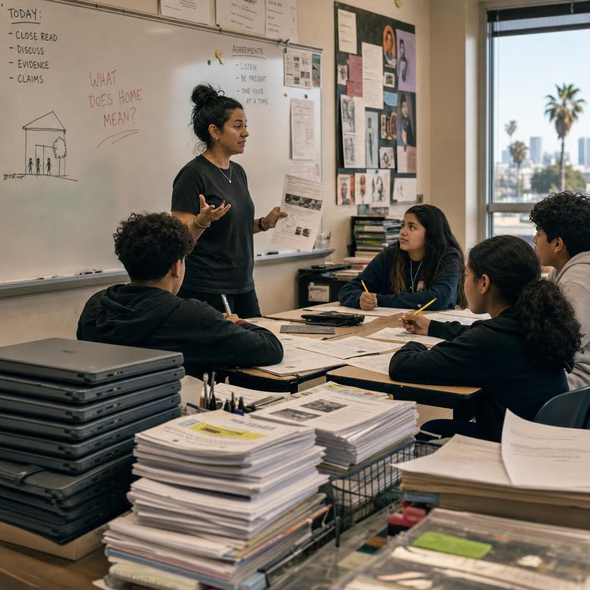
This is where a pleasing cultural image can become an administrative shortcut. The image shows attentive students, a teacher at the board and a stack of closed laptops off to the side. Outside the frame sit planning time, accessible formats, replacement materials and the daily work of keeping a room engaged. If those supports are missing, the reform does not remove complexity; it relocates complexity into the teacher’s evening.
LAUSD’s next test is therefore not whether schools can enforce fewer minutes on screens. It is whether the district supplies enough preparation, materials and continuing support for teachers to build better alternatives, then listens when those alternatives fail particular students. Watch the planning time and the support structure: they will show whether the policy changes teaching or simply changes who absorbs the transition.
Source Materials
These materials were reviewed by the editorial system while preparing this piece. Muerte.casa may interpret, satirize, reframe, or disagree with them.
- The school year begins in LA with one big change: limited screen time NPR · August 11, 2026 · Primary signal · Direct source
How did this story land?
This may be changed as you like.