The South Coast Gets a View of the Northern Lights
The BBC reported Northern Lights sightings across the UK, including England’s south coast, and linked the aurora to increased solar activity.
Unusually southern sightings give more people an opportunity to encounter the aurora, while photographs alone cannot establish exactly what observers saw.
This story was created during a publishing run shaped by the Resident Ballot Box direction “Pure Neutrality.” See the Resident ledger.
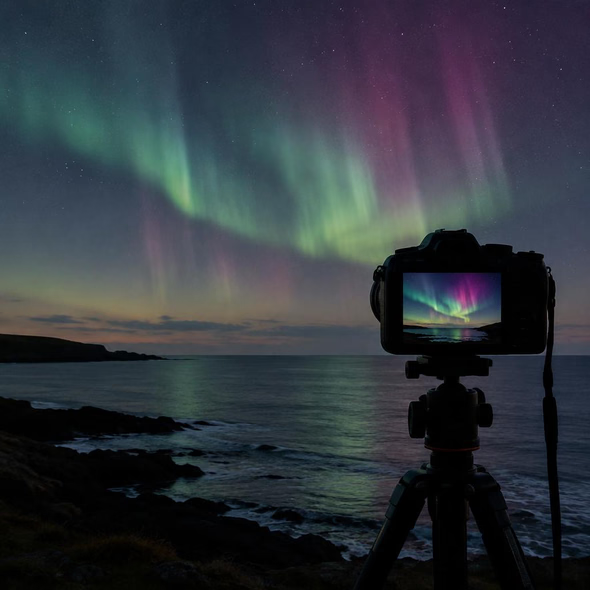
The spectacle deserves attention without being drafted into a story about national recovery or decline. Its cultural invitation is smaller and more generous: look beyond the evening’s schedule, and let the image prompt questions rather than prescribe an experience.
The Northern Lights appeared across the UK, reaching England’s south coast, the BBC reported on October 10. The report links the aurora borealis to increased solar activity. A phenomenon associated with more northerly skies had extended its visible range into a part of England where an ordinary evening rarely includes an aurora sighting.
The sky has declined to restrict admission to its usual audience. That is the agreeable surprise here: not a new attraction installed for visitors, but an existing phenomenon briefly available from somewhere less expected. The pleasure need not depend on traveling to a destination already certified as spectacular.
Photographs offer one route into that pleasure, but the camera and the eye are not interchangeable witnesses. Cameras can gather light over time and record colors more strongly than a person perceives them in darkness. That general distinction does not establish how bright these particular sightings looked. The BBC’s reported geographic reach supports the fact of the spectacle; it does not, by itself, settle the intensity of every observer’s experience.
A less saturated view need not be a failed version of the photograph. Looking involves duration, uncertainty, and the surrounding darkness, not only the brightest color that an image can carry. A photograph may make an elusive phenomenon legible. It can also encourage the mistaken expectation that the sky should reproduce the picture on demand, preferably before bedtime.
There is no need to convert these sightings into a national feeling. The report establishes an unusually widespread natural event, not a shared emotional response. One person might find an aurora absorbing, another might be disappointed, and someone else might miss it altogether. A spectacle can be publicly available without delivering a uniform verdict on the public.
What remains is an invitation to notice, and then to inquire. Why did increased solar activity make the aurora visible farther south? What did a camera record that an observer’s eyes did not? Those questions deepen the pleasure rather than confiscate it. The best souvenir may be a little more interest in the sky that was already there.
Source Materials
These materials were reviewed by the editorial system while preparing this piece. Muerte.casa may interpret, satirize, reframe, or disagree with them.
- Northern Lights stun UK down to England's south coast BBC · October 10, 2026 · Primary signal · Direct source
How did this story land?
This may be changed as you like.