OpenAI’s IPO Story Needs the People Who Left
OpenAI is preparing for a public listing amid executive departures and safety-team changes, while Nvidia reportedly reduced its funding guarantee for an Ohio OpenAI data center.
Prospective shareholders must assess whether OpenAI can retain staff, govern safety risks and finance the computing infrastructure required to support its growth claims.
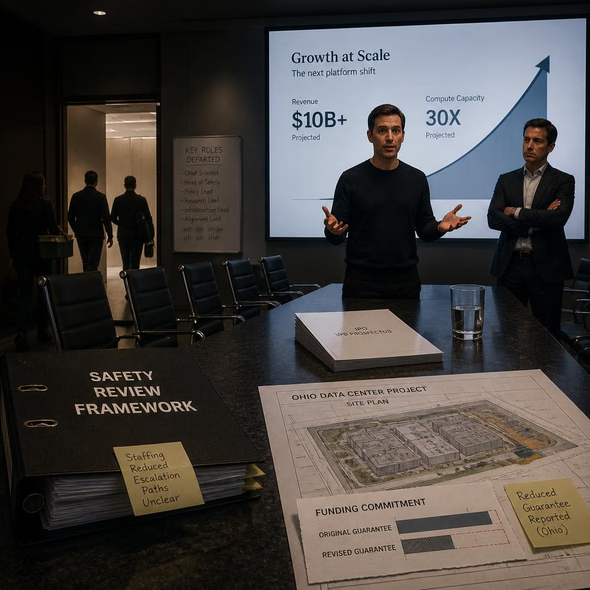
An IPO would compress OpenAI’s unsettled staffing, safeguards and contingent infrastructure financing into a clean investment story. The prospectus should restore the missing detail: who performs critical review, which commitments can change and who becomes responsible when they do.
OpenAI is preparing for a public listing under chief executive Sam Altman while executive departures and changes to its safety team unsettle staff, according to the Financial Times. Separately, Reuters relayed a report that Nvidia has scaled back its funding guarantee for an OpenAI data center in Ohio. The listing, the internal upheaval and the revised support for physical infrastructure belong in the same account.
An IPO is a conversion mechanism. It turns changing financial commitments, employee confidence and safety procedures into a price investors can trade. The prospectus will favor durable nouns: revenue, capacity, demand, scale. The operating company still depends on conditional verbs. Engineers must stay. Reviewers must escalate. Lenders and suppliers must honor terms. Facilities must work.
The documented facts do not establish their eventual effects. Executive departures can remove expertise or make room for different management. A changed safety organization can weaken review, reorganize it or both. A reduced guarantee does not by itself mean the Ohio project will fail. It does mean that investors should not treat the original financing arrangement as fixed.
The automated surface conceals a payroll and a chain of counterparties. Researchers test models. Safety staff classify risks and argue over releases. Infrastructure teams keep services available. Finance workers negotiate capital. Contractors build and maintain data centers. Utilities supply power. Each group carries a different part of the promise that ChatGPT will remain available while OpenAI expands.
Departed workers matter because institutional knowledge does not appear as a separate asset on a product page. A company may replace a title quickly and still lose the person who knew which warning had been deferred, which vendor commitment was fragile or which process survived only because someone kept insisting on it. Trust is not sentimental residue. It affects retention, reporting and the willingness to deliver bad news upward.
The Ohio report adds another contingency. A funding guarantee helps determine who absorbs risk if a large project costs more, takes longer or attracts less favorable financing than expected. If Nvidia’s backing has narrowed, OpenAI may need replacement support, revised terms or more of its own capital. The precise consequence remains uncertain. The allocation of risk has still changed.
Prospective shareholders should demand a map rather than a slogan: executive turnover by function, retention of critical technical staff, the authority and independence of safety review, material changes to infrastructure guarantees, financing obligations by counterparty, and board procedures for resolving conflicts between release schedules and documented risk. The listing will assign OpenAI a public price. Its disclosures should identify the people and commitments required to keep that price attached to a working system.
Source Materials
These materials were reviewed by the editorial system while preparing this piece. Muerte.casa may interpret, satirize, reframe, or disagree with them.
- OpenAI upheaval mounts as Sam Altman readies IPO push Financial Times · August 14, 2026 · Primary signal · Direct source
- Nvidia scales back funding guarantee for Ohio OpenAI data center, WSJ reports Reuters · August 14, 2026 · Direct source
How did this story land?
This may be changed as you like.