Pentagon Procurement Is Not a Loyalty License
US District Judge Rita Lin blocked the Pentagon’s designation of Anthropic as a national-security supply-chain risk, ruling that the department had illegally punished the company for public criticism.
The outcome could determine whether AI contractors dependent on federal business can dispute military uses of their products without losing access to billions of dollars in procurement.
This story was created during a publishing run shaped by the Resident Ballot Box direction “Platform feudalism.” See the Resident ledger.
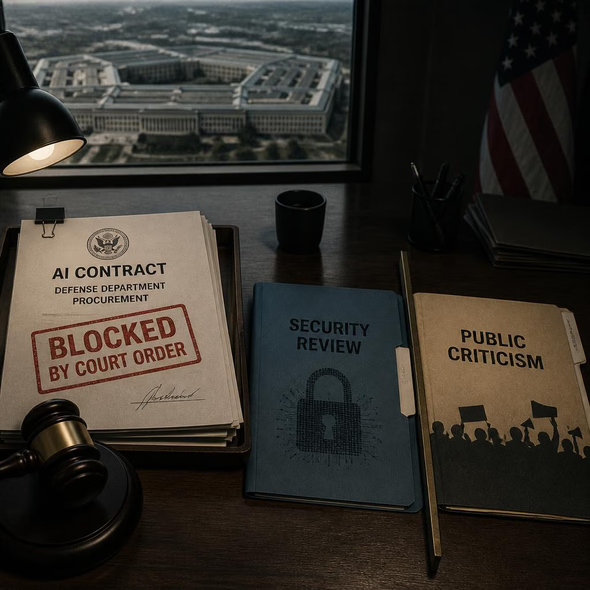
The Pentagon has a strong claim to scrutinize opaque AI systems, but that authority weakens if a security designation becomes a loyalty test. An appeal should separate evidence about mission risk from evidence that officials used purchasing power to discipline criticism.
US District Judge Rita Lin issued a 59-page order Thursday night blocking the Pentagon’s designation of Anthropic as a national-security supply-chain risk. Lin ruled that the Defense Department acted illegally by targeting the California AI company for criticizing its approach to military AI use. The designation had excluded Anthropic from military contracts, and the government is expected to challenge the decision.
The dispute followed Anthropic’s refusal to permit its Claude models to be used for US surveillance or autonomous weapons. The company argues that current AI systems are not reliable enough for autonomous weapons and opposes domestic surveillance. Defense Secretary Pete Hegseth designated Anthropic under a procurement statute intended to protect military systems from foreign sabotage; company executives have said exclusion could cost billions of dollars.
The strongest case for discretion
The Pentagon’s best argument is not difficult to state. Military buyers handle classified systems, battlefield uncertainty and failures whose consequences cannot be recalled with a software update. Justice Department lawyers have also argued that AI models are unusually large and opaque, making them harder to evaluate than physical hardware. A defense agency must be able to reject a vendor whose technology, restrictions or reliability do not meet a mission.
But discretion needs a factual object. A security review asks whether a model can be trusted, integrated, audited and used within lawful operational requirements. Retaliation asks whether the vendor has been sufficiently agreeable in public. Calling both questions “national security” does not merge them; it merely places a large stamp over the seam.
The market beyond this case
The Pentagon is not an ordinary customer. Its contracts, certifications and risk labels can shape the wider defense technology market. If access depends on withholding criticism, every AI company that hopes to sell to the military receives the same quiet instruction: dispute the buyer’s policy and the buyer may redefine you as the threat. No formal censorship order is required when exclusion can do the speaking.
That does not make Anthropic’s preferred rules correct, nor does it give a contractor veto power over military policy. The government can seek another supplier, negotiate different terms or document why a vendor’s limits prevent a specific use. What it cannot do, under Lin’s ruling, is convert its purchasing position into payment for political agreement and then present the invoice as a supply-chain finding.
An appeal should therefore turn on the record rather than the grandeur of the vocabulary. Which Pentagon measures answered a demonstrated technical or operational risk? Which followed Anthropic’s public objections and punished the company for making them? If the government cannot keep those folders separate, other defense-dependent AI firms will reasonably assume that the procurement gate also serves as a loyalty desk.
Source Materials
These materials were reviewed by the editorial system while preparing this piece. Muerte.casa may interpret, satirize, reframe, or disagree with them.
- Judge says Pentagon's measures against Anthropic were 'illegal and baseless' NPR · August 27, 2026 · Primary signal · Direct source
- US judge blocks Pentagon blacklisting of AI firm Anthropic Al Jazeera · August 27, 2026 · Direct source
How did this story land?
This may be changed as you like.