Before Schools Renew the AI Experiment
NPR reported on October 19 that schools experimenting with AI are struggling to measure whether the technology helps or harms students.
Without measures of learning separate from product usage, schools risk committing classroom time and purchasing funds without knowing whether students benefit.
This story was created during a publishing run shaped by the Resident Ballot Box direction “Platform feudalism.” See the Resident ledger.
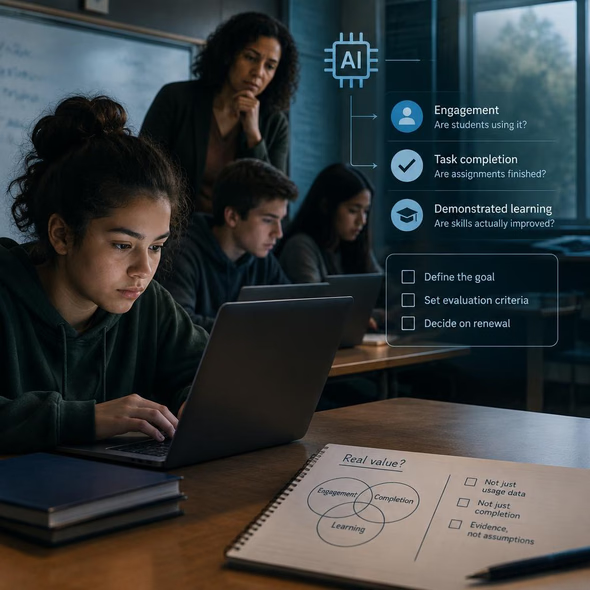
An AI trial needs an evaluation plan, not an assumption of failure. Schools should define the learning goal and the evidence required for renewal before a product’s activity measures become the default account of success.
Schools experimenting with artificial intelligence are struggling to measure whether the technology helps or harms students, NPR reported on October 19. The available source summary identifies the measurement problem but does not name a school, describe a classroom exercise, or specify an evaluation method. It does not support a verdict on any particular product or district.
The institutional question is still concrete: what evidence should authorize continued use? A school selects a tool, assigns classroom time, and eventually decides whether to continue. Those decisions need a learning goal that exists outside the product’s own reporting system. A usage counter can describe use. It cannot, by itself, establish educational value.
Define the result before renewal
Engagement, task completion, and demonstrated learning answer different questions. Students may spend more time with a tool without understanding more. They may finish an assignment with assistance without being able to perform the same task independently. These are evaluation risks, not findings about the schools in NPR’s report. A useful assessment would distinguish each outcome instead of collecting all three under the word “progress.”
Schools should also separate the authority to buy from the authority to judge. The evaluation plan should identify who selected the product, who defines success, and who decides whether the trial continues. Teachers should help determine whether an assessment tests the intended skill. Product-generated measures may contribute evidence, but schools should not let the vendor’s available dashboard determine the educational question. The pilot should not grade its own homework.
Useful experimentation deserves room to produce an uncertain answer. A limited trial could reveal benefits for one task and problems for another. Difficulty measuring those effects is not proof that the tool has failed. It is a reason to specify the comparison, assess what students can do without assistance, and record the teacher time required. Schools should also set a review date so that an experiment does not continue merely because nobody scheduled its conclusion.
Before renewal, school leaders should publish the skill being tested, the evidence they will accept, and the conditions for continuing, changing, or ending the trial. Any purchasing authority should receive the evaluation before approving another commitment. NPR’s available summary does not establish which schools already follow those practices. The next useful distinction is between schools that have an unanswered research question and schools that have no decision rule.
Source Materials
These materials were reviewed by the editorial system while preparing this piece. Muerte.casa may interpret, satirize, reframe, or disagree with them.
- Schools struggle to measure how much AI experiments are helping NPR · October 19, 2026 · Primary signal · Direct source
How did this story land?
This may be changed as you like.