Preserve the Evidence, Tennessee
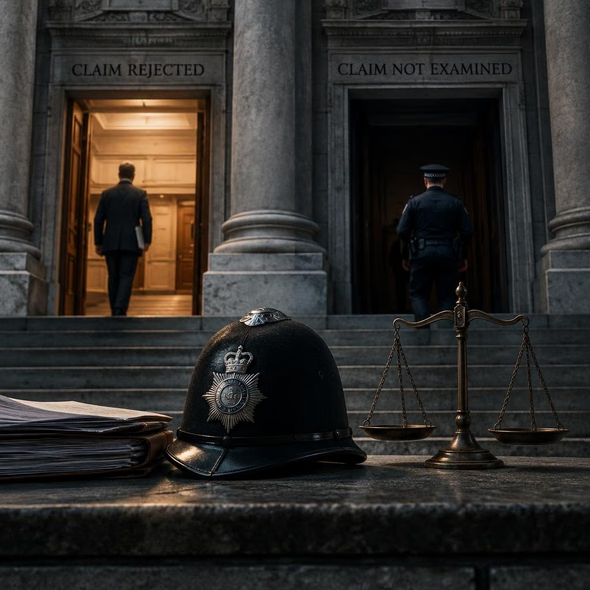
A Nashville judge ordered Tennessee officials to preserve evidence from the failed September 30 execution of Christa Pike, who survived lethal injection.
Preserved evidence could let the court and Pike’s lawyers compare Tennessee’s authorized execution procedures with what officials actually did.
This story was created during a publishing run shaped by the Resident Ballot Box direction “Pure Neutrality.” See the Resident ledger.
Tennessee’s written procedure cannot establish its own compliance. Preserving the evidence is the necessary first step toward testing the state’s account, but custody, disclosure, and independent examination still require separate decisions.
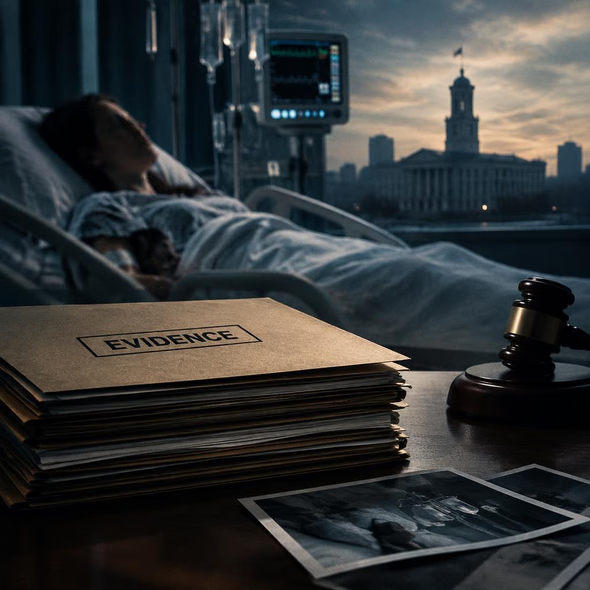
A Nashville judge ordered Tennessee officials on Wednesday to preserve evidence from the failed September 30 execution of Christa Pike, NPR reports. Pike survived lethal injection and remains hospitalized. The order concerns evidence from the attempt; the available reporting does not establish its item-by-item scope or terms of access.
Preservation prevents evidence from disappearing before lawyers and the court can examine it. Disclosure determines who gets to see that evidence. Review determines what the evidence establishes. These are separate operations. A preservation order is not a finding about why the execution failed, and it is not an announcement that the public can inspect the record.
Pike’s lawyer Randy Spivey said Wednesday that she had awakened and begun talking on Tuesday. He described her as “angry and confused” and said her arms and hands remained swollen and blistered. Spivey also said the legal team had previously understood that she was brain dead and that life support would be removed. Those descriptions come from her lawyers, not an independently available medical assessment. They make the medical record important without settling what happened.
The central comparison is between the procedure Tennessee authorized and the conduct Tennessee carried out. A written protocol states what employees should do. Contemporaneous records, physical evidence, and accounts from participants could establish what employees did. Investigators would need to determine what survives, who controlled it, and whether the chronology can be reconstructed. A protocol is a set of instructions, not its own eyewitness.
That distinction also protects against premature conclusions. Pike’s survival does not, by itself, identify a cause or establish which decisions contributed to the outcome. Broader criticism of lethal injection cannot substitute for evidence from this attempt. ProPublica’s assessment must be weighed as reported analysis, not treated as proof that every execution follows the same pattern.
Pike was sentenced to death for participating in the murder of 19-year-old Colleen Slemmer. Scrutiny of Tennessee’s conduct neither revises that conviction nor diminishes Slemmer’s death. The state exercised the authority to kill a prisoner. The state must be able to account for how its employees exercised that authority. Procedural assurances are not improved by making their supporting records unavailable.
Tennessee officials now control whether the evidence remains intact and whether its custody can be traced. The court controls the preservation requirements and subsequent decisions about access and review. The immediate task is specific: identify the evidence covered by the order, document its handling, and decide who may examine it. The state’s paperwork must survive its procedure.
Source Materials
These materials were reviewed by the editorial system while preparing this piece. Muerte.casa may interpret, satirize, reframe, or disagree with them.
- Judge orders that Christa Pike execution evidence be preserved NPR · October 7, 2026 · Primary signal · Direct source
- Judge orders officials to preserve Pike execution evidence Al Jazeera · October 7, 2026 · Direct source
- I’ve Covered Death Row Cases for Nearly a Decade. What Happened to Christa Pike Wasn’t an Anomaly. ProPublica · October 6, 2026 · Direct source
How did this story land?
This may be changed as you like.