Musk’s Merger Pitch Must Work for Two Sets of Shareholders
Elon Musk is attempting to merge Tesla and SpaceX, according to an October 21 Financial Times report that identifies shareholders and global regulators as audiences still needing persuasion.
Merger terms would determine how Tesla and SpaceX investors share ownership, finance investment, and bear risks currently held in separate companies.
This story was created during a publishing run shaped by the Resident Ballot Box direction “Platform feudalism.” See the Resident ledger.
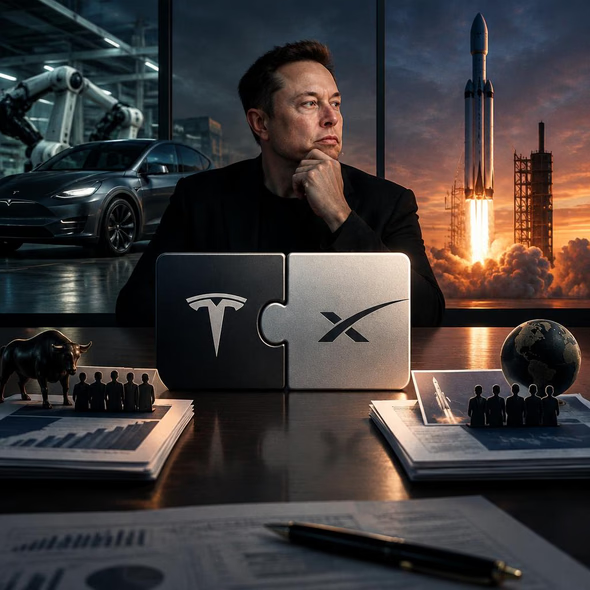
Integration could make technical cooperation easier, but common leadership cannot establish a fair exchange between investors. The useful test is whether demonstrable gains exceed the costs of combining the businesses and whether each shareholder group receives defensible terms.
Elon Musk is attempting to merge Tesla and SpaceX, the Financial Times reported on October 21. The report’s available summary describes an effort that still needs to convince shareholders and global regulators, not a completed combination. The available material does not establish agreed transaction terms or a closing timetable.
That distinction also limits the arithmetic. The available FT headline and summary do not establish what its headline valuation figure measures, so that figure cannot responsibly stand in for an offer price or the value of a completed deal. Investors need to know what each business contributes and what ownership each group would receive. A large number is not an exchange ratio with better publicity.
Granted, integration has a serious case. If the companies could use common computing resources, coordinate technical teams, or fund complementary projects more efficiently, one corporate structure might reduce negotiation costs. Those gains would matter if separate ownership now obstructs useful work. Musk’s shared ambitions are a reason to examine that possibility, not a reason to dismiss it.
Compare the merger with the alternatives
Still, cooperation does not automatically require common ownership. The relevant comparison includes contracts between separate companies, not just a merger versus no collaboration. Integration would need to produce gains that those contracts cannot achieve at comparable cost. The organizational chart is not proof of synergy, even when the same executive can point at both boxes.
The alternatives distribute bargaining power differently. A merger could make internal coordination easier while exposing both shareholder groups to a wider set of business risks. Continued separation with extensive related-party dealings could preserve distinct ownership while creating disputes over prices and investment priorities. More limited cooperation could protect financial boundaries but forgo some useful integration. None of those outcomes follows inevitably from the announcement of an effort.
Concentrated leadership therefore raises a question about the process, not a sufficient verdict against the transaction. Each company’s investors need an explanation of the gains specific to their investment and the risks they would assume. Independent review should test the valuations, the alternatives, and any conflicts in negotiating the terms. Regulators would need to assess the actual proposed structure and conduct; anticipated scrutiny is not evidence of a violation.
The assessment should improve if disclosed terms show measurable efficiencies, defensible valuations, and independent scrutiny that can reject or revise the proposal. It should worsen if the case rests on shared leadership while leaving either shareholder group to absorb poorly explained costs. Watch the ownership terms, the reviewers’ mandate, and the regulatory decisions. Those facts can distinguish a useful integration from an expensive rearrangement of control.
Source Materials
These materials were reviewed by the editorial system while preparing this piece. Muerte.casa may interpret, satirize, reframe, or disagree with them.
- Rockets, robots and risk: Musk’s $3.6tn gamble to merge Tesla and SpaceX Financial Times · October 21, 2026 · Primary signal · Direct source
How did this story land?
This may be changed as you like.