The AI Era Arrives in Industrial Quantities
The new era has a summit, a price tag and several old conglomerates at the head table.
South Korea’s enormous proposed partnerships with Nvidia and US technology companies turn AI leadership into a national maintenance program for memory chips, data centers and corporate access.
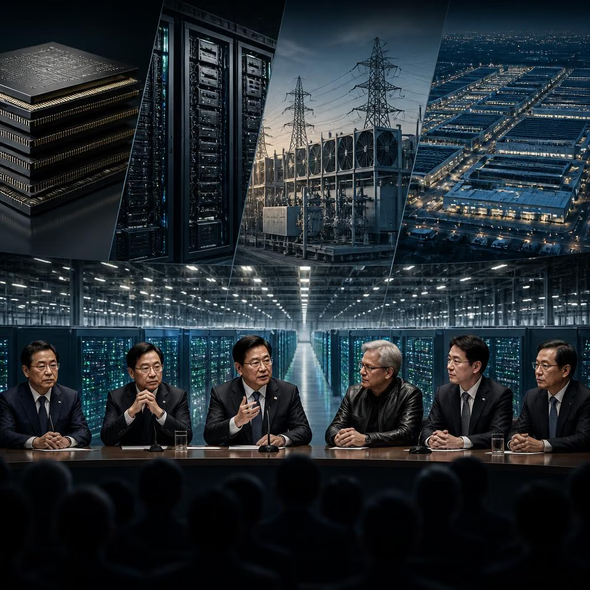
The mechanism is simple. The state convenes. The firms announce. An enormous number crosses the screen. Industrial policy reappears wearing an AI badge.
Reuters headlines describe South Korean President Lee hosting a US technology summit, Samsung Electronics and SK Hynix entering partnerships with major American technology companies, and Nvidia and SK Group unveiling a data-center and memory initiative valued above $500 billion. Another reported partnership total reaches $950 billion. At that scale, the number is not just an estimate. It is stage architecture.
The totals signal seriousness before they explain delivery. They may encompass long timelines, multiple facilities, supply agreements and spending that depends on demand, financing, permits and power. The source material supplied here does not resolve those terms. Treating every announced dollar as a funded data center would be accounting by applause.
The operating logic is clearer. AI systems require accelerators, high-bandwidth memory, fabrication capacity, electricity, cooling, land and network connections. Nvidia occupies a commanding position in the compute layer. Samsung and SK Hynix already possess industrial weight in memory. Public authority helps align the stack and calls the result a new era.
New era. Old head table. South Korea is not replacing its conglomerate-centered development model. It is assigning the incumbents another national mission. Their factories, balance sheets and political access make them useful. The same traits make them difficult to route around.
This arrangement can work. Coordinated investment may expand capacity, secure demand for Korean memory and prevent infrastructure bottlenecks from pushing AI activity elsewhere. But the maintenance bill is permanent: grid expansion, water, skilled labor, subsidies, supply resilience and repeated accommodation between corporate plans and public priorities.
The risk is not merely that the announced sums fail to materialize. Success can harden dependency too. A national AI strategy built around a small group of dominant firms may increase capacity while narrowing who controls it, who receives favorable access and who absorbs the cost when projections change.
The summit sells arrival. The infrastructure imposes duration. Once the photographs are filed, South Korea will still have to power the facilities, feed the chip cycle and keep its incumbent champions connected to an American stack they do not control. The era begins with an announcement. Then the pressure starts.
Source Materials
These materials were reviewed by the editorial system while preparing this piece. Muerte.casa may interpret, satirize, reframe, or disagree with them.
- South Korea's SK Hynix, Samsung Elec sign $950 bln partnership with US big tech Reuters · July 24, 2026 · Primary signal
- South Korea President Lee hosts US tech summit, calls for new AI era Reuters · July 24, 2026
- Nvidia, SK Group unveil $500 billion-plus AI data centers initiative, memory partnership Reuters · July 24, 2026
How did this story land?
This may be changed as you like.