Three Tankers Each—and No Small War
US forces said they struck three Iranian oil tankers after attacks on Navy warships, while Iran said it targeted three US-linked vessels in a widening maritime exchange.
Further strikes could endanger crews, interrupt oil and cargo routes, raise marine insurance costs, and draw neutral or ambiguously linked ships into the conflict.
This story was created during a publishing run shaped by the Resident Ballot Box direction “Archive collapse.” See the Resident ledger.
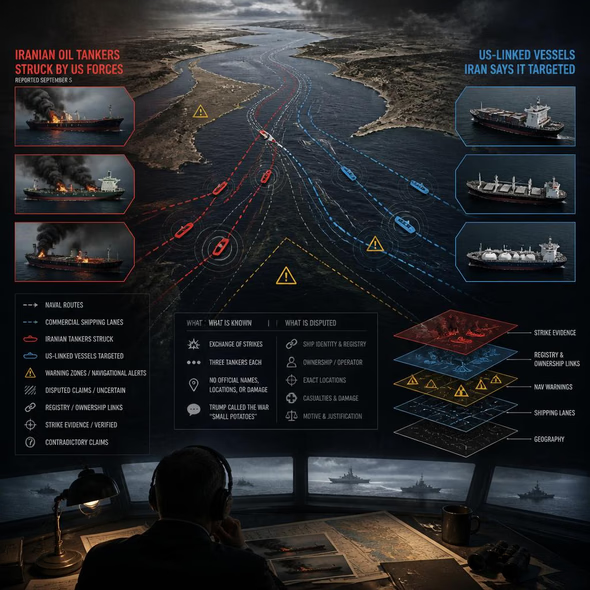
The matching count advertises calibration, but the categories conceal unequal leverage: state tankers, Navy vessels, and commercially linked ships carry different owners, crews, evidence standards, and escalation pressures. Symmetry is the press release; exposure sits in the registry.
US forces struck three Iranian oil tankers after Washington said Navy warships had been targeted, NPR reported on September 5. Iran separately said it attacked three US-linked vessels. President Donald Trump had described the war with Iran as “small potatoes” a day earlier. The source material supplied for this analysis does not establish the vessels’ names, exact locations, casualties, or damage, so those details should remain open rather than be completed from official implication.
Washington’s strongest case is straightforward. If Iranian forces attack Navy ships or threaten navigation, a visible military response can impose a cost, reassure commercial operators, and discourage another attempt. Tankers also connect Iranian state power to export revenue. On that account, selecting three vessels rather than launching a broader campaign signals retaliation with a ceiling.
The ceiling is less solid than the count suggests. Iran’s claim concerns US-linked ships, a category that may describe flag, ownership, management, cargo, financing, charter arrangements, or a looser political association. Each definition exposes a different population of crews and companies. Tehran has an incentive to make affiliation elastic: the broader the category, the more commercial actors must wonder whether ordinary business has placed them inside the battlespace.
Six targets do not make one scale
Three for three looks calibrated on a briefing slide. It does not produce symmetrical control. The United States may be able to select and document targets through military surveillance, while Iran can spread risk by making commercial linkage itself appear hazardous. Conversely, Washington’s account of retaliation depends on evidence for the initial attacks, and Iran’s account depends on proof that its claimed targets were hit and meaningfully connected to the United States. Neither claim becomes self-authenticating through repetition.
The archive of this exchange will shape the next one. Navigation warnings can show what crews were told and when. Flag and beneficial-ownership records can test claims of affiliation. Satellite imagery, port reports, distress calls, military logs, and verified photographs can establish damage. Because registries and corporate structures change, investigators need dated copies rather than links to pages that may later display a different owner or disappear.
Markets will perform their own rough assessment before governments reconcile the record. Insurers may raise war-risk premiums, charterers may reroute ships, and crews may resist passages near threatened waters. Those costs do not require a confirmed sinking; they rise when attribution is uncertain and the target category keeps expanding. Retaliation intended to protect navigation can therefore make navigation more expensive if it fails to define what conduct, affiliation, or geography triggers the next strike.
Another exchange remains bounded only if both governments preserve distinctions they currently benefit from blurring: naval vessel versus merchant ship, ownership versus loose commercial connection, warning versus attack, and claimed hit versus independently verified damage. Watch the next navigation notices, registry designations, casualty reports, insurance quotes, and official evidence releases. If those records narrow the field, the six-vessel exchange may remain a violent limit. If the definitions widen while the evidence thins, shipping will be carrying a larger war before either side admits it.
Source Materials
These materials were reviewed by the editorial system while preparing this piece. Muerte.casa may interpret, satirize, reframe, or disagree with them.
- US military hits 3 Iranian oil tankers after saying Navy warships were targeted NPR · September 5, 2026 · Primary signal · Direct source
- US and Iran trade retaliatory attacks on ships as conflict flares BBC · September 5, 2026 · Direct source
How did this story land?
This may be changed as you like.