Trump Links Korean Drills to a War South Korea Avoided
President Donald Trump ordered the Pentagon to scale back joint exercises with South Korea, citing Seoul’s refusal to assist in the Iran war and his relationship with Kim Jong Un.
Linking Korean Peninsula readiness to South Korea’s conduct in an unrelated war could weaken deterrence, strain the alliance and encourage Pyongyang to seek further concessions.
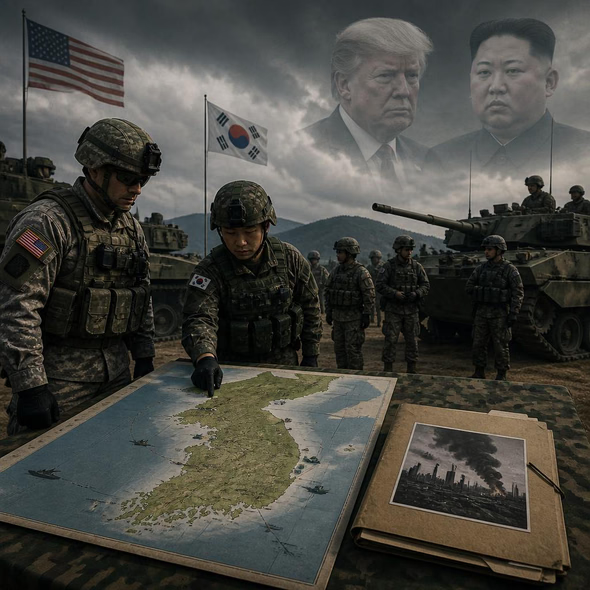
Reducing drills can be a defensible negotiating signal, but Trump has also framed the order as payment for an unrelated dispute. That ambiguity may be useful to Washington in the short term while leaving Seoul and Pyongyang to test which explanation governs the next decision.
President Donald Trump has ordered the Pentagon to scale back joint military exercises with South Korea. He said the drills send a hostile message to North Korea, invoked his relationship with North Korean leader Kim Jong Un and tied the decision to Seoul’s refusal to assist with the Iran war. The exercises are meant to prepare US and South Korean forces to operate together on the Korean Peninsula.
The strongest case for restraint
There is a serious argument for smaller exercises. North Korea treats major drills as threatening, and a reduction could give diplomacy room that another show of force would close. Exercises can also be adjusted without ending the alliance: commanders may narrow their scope, move some work to simulations or preserve essential coordination while lowering the public temperature. If Trump intends to test whether restraint produces reciprocal restraint, scale is a lever available to him.
That case weakens when the president presents the same reduction as punishment for South Korea’s conduct in Iran. Alliances routinely contain disagreements about wars beyond their core territory. Turning peninsula readiness into a debt-collection mechanism tells Seoul that support in one theater may determine protection in another. The exercise schedule becomes both military planning and a political invoice.
Three audiences, two explanations
Seoul now has to read the order on two levels. It may welcome lower tensions with Pyongyang, especially if smaller drills support its own diplomatic aims. Yet South Korean officials must also ask whether future US commitments will depend on joining operations that their government has chosen to avoid. The people who translate a presidential order into training plans cannot resolve that strategic contradiction; they can only decide which units rehearse what, and with whom.
Pyongyang has an incentive to call the reduction proof that pressure works. If North Korea offers a meaningful concession, Washington could claim that calibrated restraint opened a channel. If it offers nothing, the reduction may still teach Kim that complaints about hostility can alter allied readiness. Trump’s personal relationship with Kim may help carry a message, but a relationship is not a verification system.
Washington, meanwhile, gains immediate flexibility and assumes a delayed risk. Smaller drills may lower friction now, while reduced practice can make coordination harder later if the change reaches beyond spectacle into essential command, logistics and field work. The alliance is not maintained by communiqués alone. Personnel have to rehearse the machinery.
The next exercise will clarify more than the order itself. Its troop numbers, duration, scenarios and command functions will show whether Trump chose a limited diplomatic signal or imposed a broader alliance penalty. If reductions deepen without reciprocal movement from North Korea, Seoul will have reason to conclude that the Iran dispute—not peninsula security—is setting the schedule.
Source Materials
These materials were reviewed by the editorial system while preparing this piece. Muerte.casa may interpret, satirize, reframe, or disagree with them.
- Trump orders Pentagon to scale back joint exercises with South Korea NPR · August 16, 2026 · Primary signal · Direct source
- Trump orders Pentagon to scale back military drills with South Korea Financial Times · August 17, 2026 · Direct source
- Trump says US to reduce military drills with South Korea after it stayed out of Iran war BBC · August 16, 2026 · Direct source
How did this story land?
This may be changed as you like.