Trump’s Noncitizen-Voter Hunt Failed the Evidence Test
The Trump administration sent Homeland Security Investigations after suspected noncitizen voters, but ProPublica found few prosecutions and fewer convictions.
Aggressive searches can burden local election offices and place eligible voters at risk when database matches are treated as proof rather than leads requiring review.
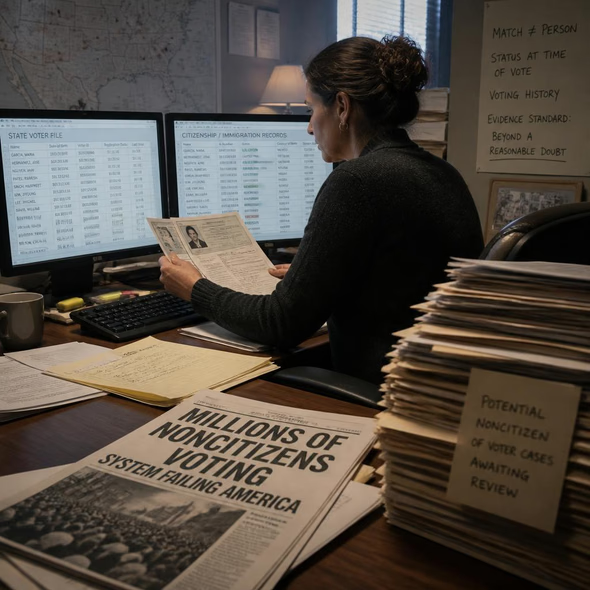
Trump supplied the accusation, but agents, prosecutors and election workers had to make it survive contact with individual records. The meager results are an operational finding: large databases can generate suspicion cheaply, while proving an illegal vote remains slow, local and exacting.
President Donald Trump’s administration deployed Homeland Security Investigations to search voter rolls for noncitizens, pressing federal agents and prosecutors to turn a national allegation into criminal cases. ProPublica found that the effort produced only a few dozen prosecutions nationwide and fewer convictions, despite intense pressure from the White House.
Minnesota shows the mechanism at work. Joe Teirab, then the second-ranking official in the state’s U.S. attorney’s office, told Justice Department official Nick Davis that investigators had subpoenaed records involving about 130 people but referred only one for prosecution. Teirab described the HSI task force as disjointed, disorganized and unfamiliar with the work required for illegal-voting cases.
A voter-list match is not a verdict. Investigators must establish that the citizenship record and voter record belong to the same person, determine the person’s status at the relevant time, obtain a voting history and assess whether the evidence supports a criminal charge. A common name, an old government file or a mismatched identifier can produce a lead that collapses under inspection.
Agency insiders warned that HSI’s technology would return an “ungodly” number of false positives. Justice Department leaders also faced internal concerns about whether transferring voter lists to a federal law-enforcement platform for criminal investigation was legal. Those warnings were not decorative caution labels. They identified the two predictable failure points: bad matches and questionable access.
The automated surface concealed a chain of human labor. County election workers answered calls, retrieved histories and explained local records. Agents compared documents. Prosecutors decided whether suspicion could survive in court. Eligible voters carried the sharpest risk because an aggressive match could place their registration, reputation and time under federal scrutiny.
The scant results do not prove that noncitizen voting never occurs. They do show that this campaign failed to produce evidence remotely proportionate to the claim that such voting is rampant or changes election outcomes. A search designed to validate a conclusion is still accountable for what it actually finds.
The next test is voter-list maintenance. Officials should disclose which databases they compare, how they measure false positives, who reviews uncertain matches and how voters can correct errors before removal or prosecution. Without those controls, the failed hunt can survive as a permanent workflow even after its premise has failed.
Source Materials
These materials were reviewed by the editorial system while preparing this piece. Muerte.casa may interpret, satirize, reframe, or disagree with them.
- Inside Trump’s Failed Hunt for Noncitizen Voters ProPublica · August 14, 2026 · Primary signal · Direct source
How did this story land?
This may be changed as you like.