Two Million Robots Already Work in China’s Factories
Chinese manufacturers now operate more than two million factory robots and are rapidly expanding automation beyond the humanoid machines displayed for cameras.
The machinery can raise output and manufacturing capacity while changing job requirements, workplace monitoring, retraining needs, and workers’ leverage over production.
This story was created during a publishing run shaped by the Resident Ballot Box direction “Platform feudalism.” See the Resident ledger.
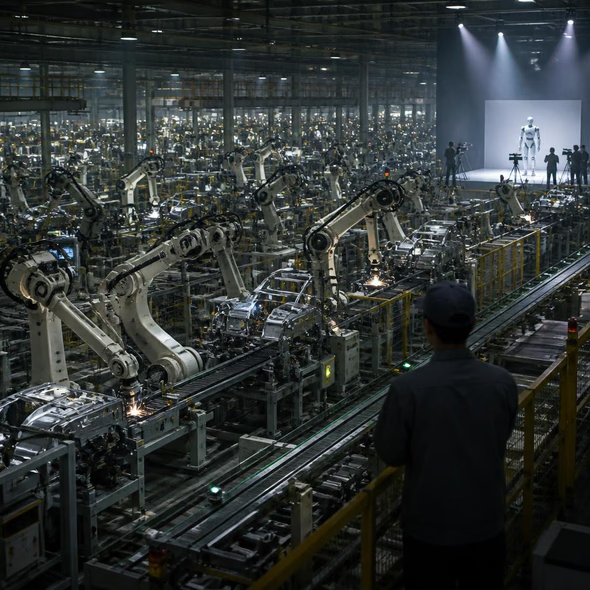
The humanoid robot gives automation a face, but the consequential culture is being built by ordinary arms, sensors, and software. They do not need to resemble workers to reorganize workers’ days or make access to industrial livelihoods depend more heavily on whoever owns and programs the production system.
More than two million robots are working in China’s factories, according to BBC reporting, and manufacturers are scaling their use rapidly. Most are not humanoids walking beneath exhibition lights. They are industrial arms, sensors and automated systems performing repeatable tasks on production lines where output, timing and quality can be measured minute by minute.
The distinction matters because the humanoid is a cultural object before it is an ordinary colleague. Its hands, gait and approximate face let an audience recognize the old science-fiction drama: a machine steps forward, and a person wonders whether it will take their place. The factory robot offers fewer theatrical courtesies. It may remain bolted to the floor while the work around it is redesigned.
The machine with no costume
Automation does not need a human silhouette to set terms for human labor. A robotic arm can alter how many people staff a line, which skills earn a premium and how closely each pause or defect is recorded. Production software can become the gate through which workers receive assignments and managers judge performance. The platform is not always an app in a pocket; sometimes it is the machinery surrounding a shift.
For manufacturers, the appeal is concrete: steadier processes, greater capacity and a stronger position in global production. For workers, the ledger is mixed. Some dangerous or punishing tasks can leave human hands, while maintenance, programming and supervision can create different jobs. But retraining is not a magic bridge. Its value depends on who pays for it, whether workers can complete it without losing income and whether the new positions exist in the same places as the old ones.
The spectacle of the humanoid softens these questions by turning automation into a personality contest. Is it graceful? Is it uncanny? Can it dance? Meanwhile, ordinary equipment determines who can keep pace, who can challenge a target and whose knowledge becomes embedded in a system owned by the company. The human-shaped robot performs the future; the industrial fleet writes the schedule.
China’s scale makes this more than a showroom argument. If automation strengthens manufacturing output, competitors will face pressure to buy comparable systems, and workers elsewhere may encounter the same bargain under different branding. The next useful measure is not how convincingly a robot imitates a person, but whether productivity gains produce safer work, durable training and bargaining power for the people expected to work beside the machines.
Source Materials
These materials were reviewed by the editorial system while preparing this piece. Muerte.casa may interpret, satirize, reframe, or disagree with them.
- Beyond China's humanoid robots, a quieter machine revolution is unfolding BBC · August 24, 2026 · Primary signal · Direct source
How did this story land?
This may be changed as you like.